


Trainee teacher numbers have grown by 11 per cent this year, with government over-recruiting would-be primary teachers but still missing its target for secondary.
New data released by the Department for Education this morning shows there were 32,175 new entrants to initial training in 2025-26 – up from 28,898 in 2024-25.
It comes as the government works to fulfil its election pledge of growing the teacher workforce by 6,500.
The number starting postgraduate training – the most common entry route – rose by 10 per cent to 26,620, while undergraduate entrants also rose by 16 per cent, to 5,555.
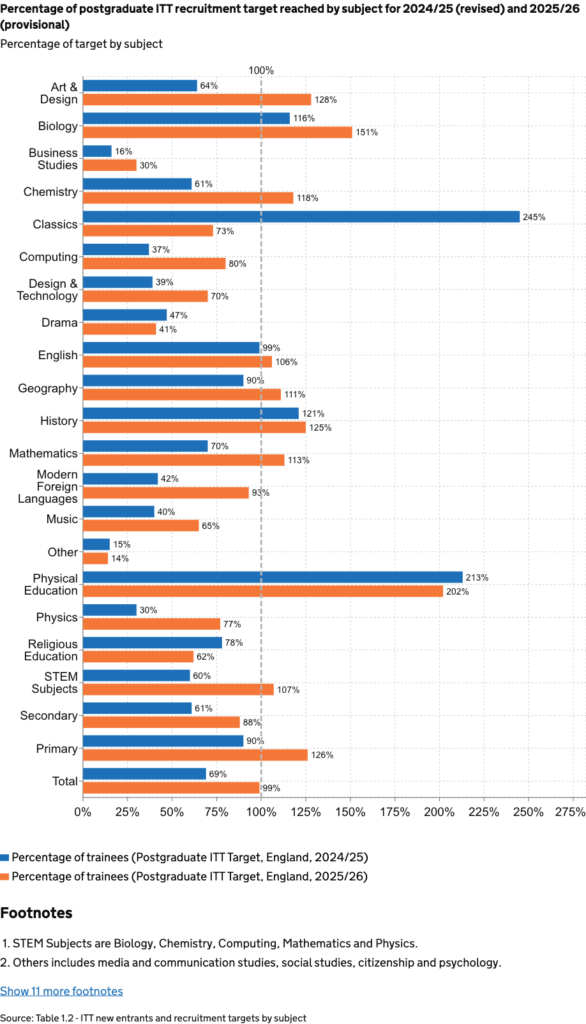
Last year, the government met just 90 per cent of its target for postgraduate primary teacher recruitment. This year it over-recruited, hitting 126 per cent.
The postgraduate target for secondary has not been met since 2012-13, except for a spike during the pandemic in 2021-22. This year 88 per cent of the DfE’s target was met – up from 61 per cent last year.
Boost after targets cut
Across secondary and primary, postgraduate initial teacher training (PGITT) hit 99 per cent of its target. This is up from 69 per cent last year.
This is driven both by an increase in PGITT entrants, and a 19 per cent reduction in the target, which was cut from 33,355 in 2024-25 to 26,920 in 2025-26.
Jack Worth, education workforce lead at the National Foundation For Educational Research, said: “Improved recruitment to postgraduate teacher training in England is welcome after years of severe under-recruitment.”
But he said while targets for core subjects including English, maths and sciences have been met, “overall secondary recruitment still falls short of the numbers require”.
“Further policy efforts to improve teacher recruitment and retention will be needed to maintain the stronger recruitment, reverse the impacts of previous persistent under-recruitment and deliver on the Government’s objective to recruit 6,500 new teachers.”
How have subjects fared?
Just eight of 18 secondary subjects hit their target: art and design (128 per cent), biology (151 per cent), chemistry (118 per cent), English (106 per cent), geography (111 per cent), history (125 per cent), maths (113 per cent) and PE (202 per cent).
Art and design, English, geography and maths had all under-recruited last year.
Business studies was the worst-performing subject against its target, hitting just 30 per cent. This marks an improvement on last year when just 16 per cent of its target was hit, and an increase in trainees from 214 to 271.
The raw number of trainees grew in every secondary subject except English, where trainees fell from 2,316 last year to 2,059 this year, and Classics which fell from 54 to 44.
‘Positive signs’ but increase ‘very small’
Pepe Di’Iasio, general secretary of the Association of School and College Leaders (ASCL), said while there are “some positive signs…the target has been missed in around half of all secondary subjects, despite targets being substantially reduced in many cases.
“While improvements in subjects such as music and design and technology are to be celebrated, the actual increase in the number of new teachers is very small.”
DT trainee numbers increased by just 58 this year (from 622 last year to 680) while music trainees rose by just 22 (from 345 to 367).
But because of reduced targets, DT hit more of its target this year (70 per cent) than last year, while music achieved 65 per cent of its target.
Di’Iasio added: “The reality on the ground is that school leaders are struggling with staff shortages in many subject areas.”
He said the government “cannot afford to rest on their laurels and think that one year of slightly better recruitment can fix such a widespread problem.
“We need to see sustained growth over many years. This will require improvements to pay and conditions in order to attract greater numbers of people into teaching, and to keep them there in the long term.”
The DfE has recently faced criticism after choosing to reduce bursaries and scholarships designed to help attract applicants to shortage subjects, following signs of improved recruitment.












Your thoughts