

Ministers will for the first time cap the fees independent special schools can charge councils for provision, with the education secretary vowing to “crack down on providers who put profit before children”.
The institutions will be subject to “new national price bands” which will “end unjustified fee variation for the same provision, giving councils the confidence to challenge poor value placements”.
And new “statutory SEND-specific standards” will “ensure every independent special school delivers consistent, high-quality support and clear outcomes for pupils”.
It comes after reports suggested the government planned to set an upper limit of £60,000 on fees. This has not been officially announced, nor have the price bands being proposed been set out.
The schools white paper, due to be published next week, will also ensure “full cost transparency will show exactly how public money is spent”.
And ministers will give councils a “formal say” on new or expanding independent provision “so places are created where children actually need them”.
Soaring spending exposed
Schools Week has revealed the soaring spend by councils on independent special schools amid the state capacity crisis in recent years.
Our award-winning investigation unveiled the big companies involved making millions, including those backed by private-equity investors and a Middle East sovereign wealth fund.
Several of these firms also run children’s homes. Ministers announced a profit cap on the children’s social care sector last year.
Recent DfE analysis found of the 15 private equity funds that own independent special schools, five are based outside of the United Kingdom. This includes Jersey, Guernsey, USA, Qatar and Abu Dhabi.
Collectively, these own 170 schools – 19 per cent – with nine thousand pupils.
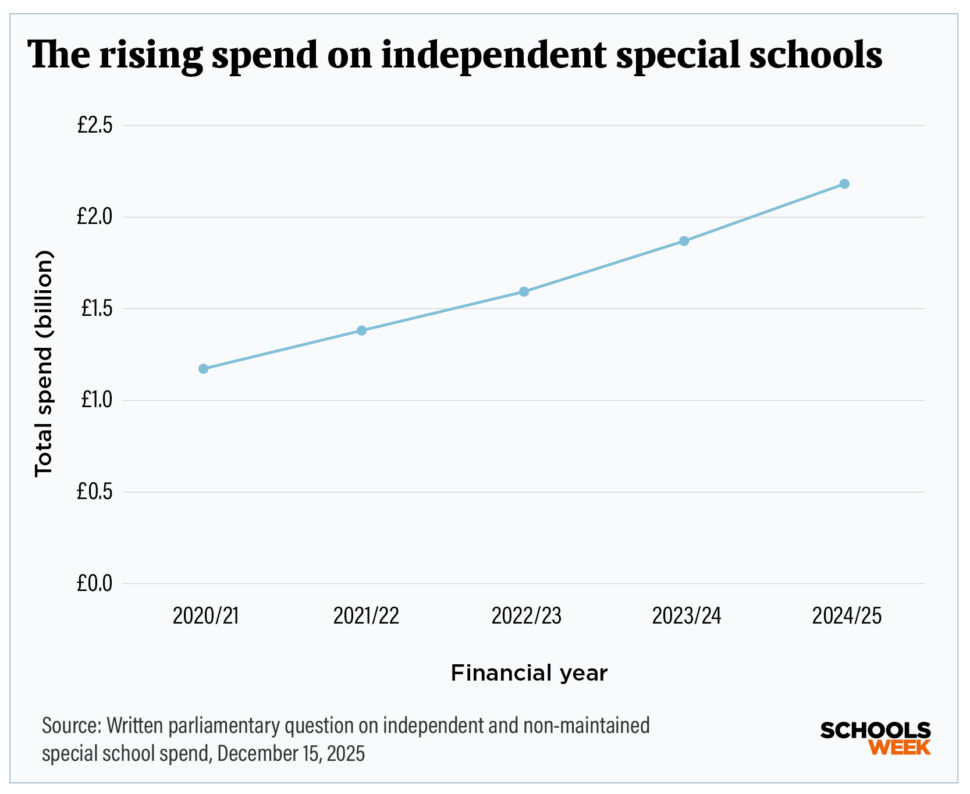
In 2024-25, councils spent £2.1 billion on independent special school and non-maintained special school places. The latter are usually run by not-for-profit charitable organisations.
This is the first time it has gone over the £2 billion mark. It has risen 88 per cent from £1.1 billion in 2020-21.
The DfE said these schools charge an average of £63,000 per child per year, which is more than twice the £26,000 cost of a state special school.
Fees vary but some independent special schools charge more than £100,000 a year.
Phillipson decries ‘profit before children’
The government said more than 30 per cent of the schools were backed by private equity firms, with “public money intended for children and young people with the most complex needs instead flowing into private profit”.
Education secretary Bridget Phillipson said: “For too long, families have faced a postcode lottery – fighting for support that depends on where they live, not what their child needs. That ends now.
“We’re cracking down on providers who put profit before children. New standards and proper oversight will ensure every independent special school placement delivers real outcomes for children – not unreasonable bills for local authorities.
“This is about building a system where every child with SEND can achieve and thrive, at a school that’s right for them and delivers the life chances they deserve.”
The proposals have been welcomed by Louise Gittins, who chairs the Local Government Association.
“While in some cases an independent school can be the best place for a child to attend, it is wrong that when councils’ own costs are soaring that some providers are setting unreasonably high prices and making significant profits from state-funded placements,” she said.
Don’t ‘scapegoat’ schools
But Claire Dorer, chief executive of the National Association of Special Schools, which represents state and private schools, said these settings “currently fill gaps where local capacity simply does not exist”.
“Scapegoating these schools as driving costs does a disservice to special schools and the crucial role they have played in shoring up a dysfunctional SEND system.”
She added: “Debates that focus solely on cost ignore the true value of specialist provision and rarely make valid like-for-like comparisons of provision. Independent special schools support children who require the most complex, multi-disciplinary support.”
Pepe Di’Iasio, general secretary of the Association of School and College Leaders, said price bands seemed “sensible and logical”, but said the government “must ensure that prices are set at a level which is sufficient to meet the needs of children who require significant support. The devil, as ever, will be in the detail.
“What is certain is that it will not serve anybody’s interests if independent specialist provision ends up being unviable to run and children are left without the support they require.”
“The use of independent specialist provision is driven by the complexity of children’s needs and the shortage of places in state-funded special schools. These pressures show no signs of abating in the foreseeable future and this provision will therefore continue to play an important role in the national system of SEND support.”









Your thoughts