


School nurseries lack the staff, space or demand to offer more wraparound, holiday or pre-school childcare, particularly in poorer areas, research shows.
The government has promised £400 million towards “tens of thousands of places” in school-based nurseries (SBNs), focused mainly on poorer areas.
Now its own research has found school-based nurseries are already more common in deprived areas, but they typically offer far less holiday, before- and after-school or under-three childcare than other nurseries.
Such additional provision is particularly limited in poorer places, attributed to lower demand from parents, despite this extra care offering “specific benefits” to disadvantaged children.
Fewer school-based nurseries offering extra care
IFF Research, which was commissioned to do the report, analysed the government’s 2024 sector survey, with 1,900 school nurseries participating, and interviewed 22 representatives.
It found just 27 per cent of school-based nurseries accepted children under three, versus 95 per cent of other nurseries.
Among school nurseries accepting under-3s, most only accepted two-year-olds. Just 8 per cent admitted under-2s.
Only one in five offered out-of-hours childcare, compared to almost four in five in other settings.
Just 6 per cent opened during holidays, versus 66 per cent of other providers.
Poorer areas have least out-of-hours and holiday care
Most said they offered ‘non-typical’ provision – care during holidays, before or after school or for under-threes – to meet demand from parents, particularly working ones.
Nurseries also said this additional provision had “specific benefits” for disadvantaged children and those with special educational needs and disabilities (SEND).
Caring for under-3s helped with “earlier identification and intervention” on SEND and disadvantage.
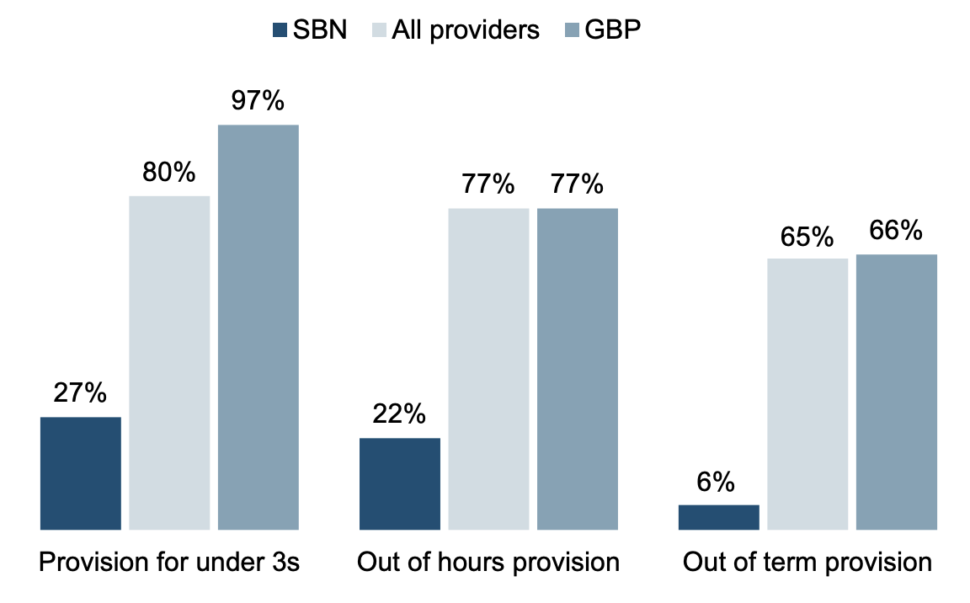
School-based nurseries were more common in poorer areas, “showing they are in a particularly good place to support these families,” researchers said.
However, in less deprived areas, nurseries were less likely to offer out-of-hours and out-of-term provision, “likely reflecting the working status of and therefore demand from the parents.”
Shortages of staff and space
Recruitment and retention were a “major barrier” reported to expanded care, however.
For under-3s, the main challenge was staffing ratios, which are 1:3 for under-2s, 1:5 for two-year-olds and 1:8 for over-3s.
There were also “logistical barriers”, like “not having sufficient or suitable space”.
For out-of-hours and holiday care, nurseries had concerns about changing staff contracts and rotas, and getting consent from leaders.
Some nurseries see lack of parental demand
Some nurseries also described an apparent lack of demand. Some suggested extra provision was not financially viable.
The report concluded school nurseries “would need to be reassured that they would be supported financially”.
They would need an “external push” as expansion is “not…currently a priority” for some.
It said any funding “would likely need to be explicitly tied to non-typical provision”, and should come with “clear guidance” around delivery and staffing requirements.
New phase targeted at the most disadvantaged
The first phase of the government’s programme saw £37 million allocated for 300 new or expanded primary school nurseries.
Phase two involves £45 million for 300 more nurseries, targeting disadvantaged communities.
This week, the government is inviting councils to develop multi-year funding proposals for school-based nurseries as part of a third phase.
The Department for Education (DfE) said applicants will be ranked on both affordability and disadvantage, based on free school meal eligibility and the income deprivation affecting children index (IDACI).
Ofsted rewrites its homework
It comes just as Ofsted republishes its analysis of childcare availability in different areas nationwide, painting a markedly different picture.
Its data previously omitted school-based nurseries, despite them making up almost a quarter of places. Ofsted had lacked the data as SBNs do not register with the inspectorate, but it has now sourced it from the DfE.
Revised data shows the north east has the third highest nursery availability when school provision is included in the calculations – whereas before it was the bottom-ranked region.
On a local authority level, Hartlepool sees the biggest change. Its childcare accessibility ranks in the bottom 5 per cent of LAs when measuring Ofsted-registered provision alone, but including schools elevates it into the top 25 per cent.
Meanwhile Leicestershire and the Isle of Wight both fall from the top 30 per cent of areas for availability to the bottom 20 per cent.
Ofsted said that while including SBNs in its calculations “changes the level of relative childcare accessibility” in some areas, “variation[s] remain and we see clusters of low accessibility particularly in deprived areas”.
“This means parents and carers experience very different levels of access depending on where they live,” said Ofsted, adding: “All families deserve access to high-quality nursery provision.”












Your thoughts