

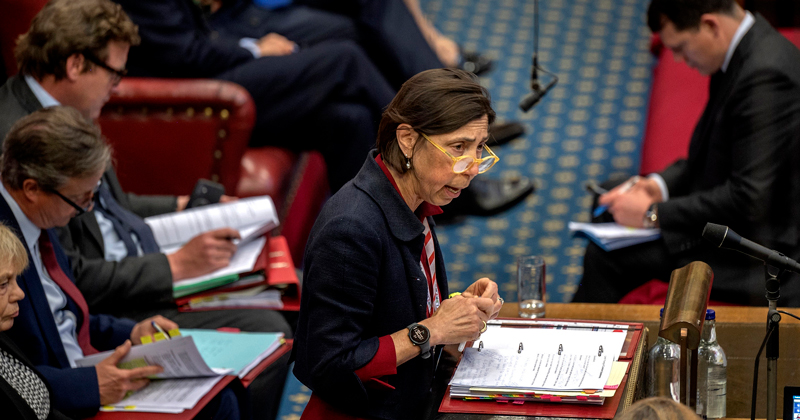
The House of Lords is gearing up for a showdown with MPs over academy admissions and school phone bans, after peers passed a slew of Conservative amendments to the government’s landmark schools bill.
The children’s wellbeing and schools bill, which proposes sweeping reforms to academies, children’s social care, home education and Ofsted powers, passed in the House of Commons with ease last year.
But Keir Starmer’s party lacks a majority in the Lords. Conservative peers have seized the opportunity to water down some areas and strengthen others.
Any peers’ amendments passed in the current ‘report’ stage then return to the Commons, in a process known as “ping pong”. The two chambers will pass the bill back and forth until agreement is reached. Labour’s Commons majority means most opposition amendments will ultimately fall, however.
The Conservative amendments come as David Cameron, who oversaw many of the Tories’ flagship school reforms as prime minister, criticised the “totally destructive attitude of Keir Starmer’s government to the education reforms that Tony Blair started and under which I put rocket boosters”.
Cameron warned the unamended bill would place “much of the remarkable progress we made in peril without any evidence that the changes will improve a single school”.
“They are undoing the freedoms that made academies and free schools great, bowing to the union demands I helped Tony Blair fight all those years ago.”
Beefed-up schools adjudicator riles Lords
The original bill proposed to not only align rules between academies and council-maintained schools, but also let the schools adjudicator set published admission numbers (PAN) for all schools.
They would have powers to reduce any school’s PAN, including academies – for instance if a council objects to an academy keeping numbers fixed or expanding while rolls fall elsewhere.
Many government critics fear this would stop stronger schools expanding.
The Lords this week passed an amendment blocking adjudicator intervention if the school “is not operating at or above” its PAN, and has been judged as high-quality by Ofsted.
The adjudicator would also have to consider “the desirability of giving effect to parental preferences” and avoid measures that “unduly restrict access to schools that are providing high-quality education or that are in strong demand”.
Diana Barran, shadow education minister in the Lords, acknowledged this week a “practical problem in some areas of falling pupil numbers”.
“But the way to sort this out is not by requiring the most popular, highest-performing schools in an area to cut their PAN. It pays no regard to the interests of children nor to the rights of parents to choose a high-performing school.”
Skills minister Jacqui Smith told the Lords school quality “will always remain a central consideration, while allowing for flexibility to adapt to changing circumstances”.
But Labour was defeated, and the amendment passed.
Peers back ban on phones and cap on uniform costs
Fresh from voting for a ban on social media for under-16s last week, the Lords also passed an amendment this week that would force schools to ban phones during the day.
The government has resisted a statutory ban, but many Labour MPs support one. Ministers may therefore struggle when the amendment reaches the Commons.
It comes after peers also passed a Liberal Democrat amendment last week that would change a proposed cap on the number of branded uniform schools can require. It backed a cap on uniform costs instead, passing with Tory support.
Home education
Meanwhile Labour faces further battles over the bill’s reforms to home education. One would require families of children currently subject to a protection plan or enquiry to seek council permission to educate at home.
The Lords voted last week to extend the clause to all children ever been subject to enquiries or on the child protection register previously.
But Smith said it would be “disproportionate in its impact”, drawing many people within scope.
“Do we really want to treat disabled children differently simply because their parents have asked voluntarily for some help, or because they were in care before adoption?
“I know of cases where children were taken into care at the request of the wife during proceedings against an abusive husband.”
‘Restore some common sense’
Laura Trott, shadow education secretary, told Schools Week the Conservatives’ upper-house victories would “restore some common sense”.
“As the bill returns to the Commons, there is still time to reverse some of the damage that will be caused.
“Labour should put ideology aside and back measures that protect children, support families and uphold standards, because the cost of getting this wrong will be felt by the most disadvantaged.”



Your thoughts