

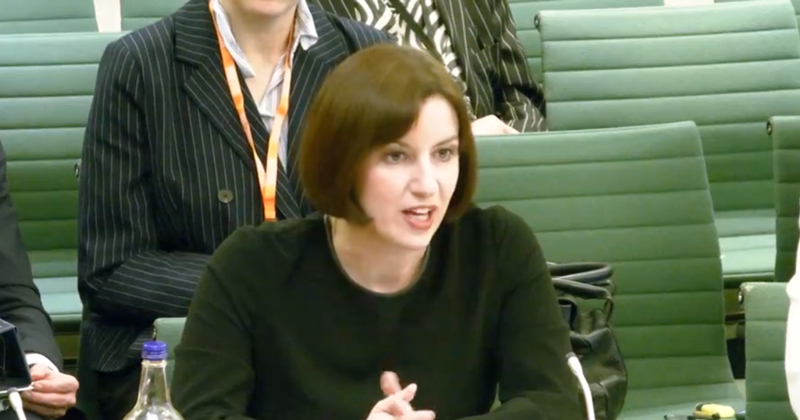
Abuse of headteachers over phone bans in their schools is “completely unacceptable”, the education secretary has said, after an MP reported that one leader was “spat and sworn at”.
But Bridget Phillipson insisted leaders already “have the powers” to ban phones, as she continued to resist calls for a national statutory ban.
The education secretary appeared in front of the Parliamentary education committee, alongside Department for Education permanent secretary Susan Acland-Hood.
Here’s what we learned during the meeting…
1. Head abuse over phone bans ‘unacceptable’
The government has repeatedly resisted calls for a statutory ban on phones in schools, with non-statutory guidance already encouraging schools to restrict their use.
Lib Dem MP Caroline Voaden said heads had described the “transformational effect” of a total phone ban.
But she said they experienced “a vocal pushback from a minority of parents”.
“One said that he’d been spat and sworn at by parents for his decision to do this.”
Phillipson said the incident Voaden described was “completely unacceptable” and something “no one in education should face”.
But she added that leaders “do have the powers” to ban phones, adding: “There are different ways of schools implementing that”.
“The evidence we have is that phones are already [being] prohibited. Schools should enforce that.”
A report by the Children’s Commissioner recently found almost all schools – 90 per cent of secondaries and 99.8 per cent of primaries – restrict phones in some way. But just 3.5 per cent are imposing total bans.
2. Officials advised ministers on 6,500 teachers target ‘definition’
Labour has come under fire for repeatedly moving the goalposts on its manifesto commitment to recruit 6,500 new “expert teachers in key subjects”.
They ditched the word “expert” from the pledge last year and the target has been broadened to include all subjects.
But Acland-Hood told MPs this week civil servants had looked “quite carefully at how to advise ministers on how to define the target” after Labour formed its government.
They have since “landed on” a definition of “secondary, special [schools] and … FE”.
“Because we’re seeing demographic growth…we do need more teachers, even in non-shortage subjects,” said Acland-Hood.
But she stressed the DfE will “keep looking at the individual subjects as well” and will be “tracking very carefully to make sure we aren’t recruiting them all in areas where we’ve got…less need.”
“We really want to make sure that we don’t hit the target and miss the point.”
3. Officials felt SEND deficits would be a ‘short-term change hump’
Phillipson and Susan Acland-Hood were questioned about plans to move SEND cost pressures onto the government’s books from 2028, and about historic council deficits due to balloon to 2028.
Acland-Hood told MPs that following 2014 reforms to the SEND system, “we started to see local authorities reporting deficits in the mid 2010s and by the end of 2018-19, about half of local authorities had an overspend on their DSG.
But “because the 2014 SEND reforms were still bedding in, and we were still going through a process of change at the time, I think it was felt that this might be a short term change hump, essentially”.
This prompted the introduction of the override and programmes with councils to try to bring deficits down, she said.
But “the short version of what happened is that, although we are really confident, without those programmes, the deficits would have been even worse, they weren’t sufficient to stop the deficits growing.
“And I think it doesn’t look like it was a short term change hump. It looks like it was a more sustained challenge.”
4. Is prevalence of English blocking language take-up?
While entries to Spanish GCSE increased this summer, they decreased for both French and German GCSE. Languages saw a similar trend at A-level.
The government’s decision to scrap the EBacc as part of the curriculum and assessment review has also prompted concerns it could cause a dip in language take-up.
Phillipson told MPs the fact English is so widely spoken poses “a challenge”.
“The ease with which we can all travel around the world and speak English, that does sometimes make it a bit trickier to persuade students that it might be for them,” she said.
5. No date for trans guidance
The education secretary was unable to say when final guidance on supporting trans pupils for schools will be published, despite having previously said it would be out this year.
Draft guidance was published under the previous Conservative administration.
But Schools Week revealed at the time the government’s own lawyers had warned schools face a “high risk” of successful legal challenges if they followed several elements of the guidance.
Phillipson said the Labour government had been looking at the draft guidance “very carefully”, adding: “This is an important and obviously delicate area.”
“We do intend to publish this guidance,” she said. But pressed by MPs for a “ballpark”, she said: “I’m afraid I’m not able to give you a date for it.
“I do recognise its importance, but I also believe it’s important that we get this right for young people, for their wellbeing, but also for schools, so that they’re confident and clear about the guidance that set out.”
6. DfE ‘should have spotted’ AI attendance reports gaffe
Phillipson and Acland-Hood were also quizzed on the DfE’s recent error, which saw AI-driven attendance reports suspended just days after being launched after school leaders noticed errors in the reports.
“When you try and do something new, you run a little bit more of a risk of making those difficulties,” said Acland-Hood.
“We should have spotted it before they went out. We really tried to correct it very quickly after it was spotted.”
She added that the DfE has “looked at what caused those errors, and are learning the lessons for the future”.
Schools Week revealed last week how heads were still facing problems with the re-issued reports.










Your thoughts