

Union leaders are demanding “urgent clarity” on how schools will qualify for exemplar schemes, such as teaching school hubs, that previously required a ‘good’ or ‘outstanding’ Ofsted rating as an eligibility benchmark.
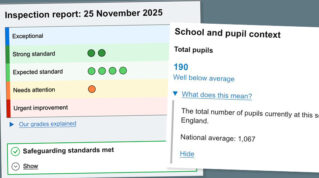
Headline grades were abolished in September 2024, and are being replaced with a new “report card” system following a major overhaul of inspections.
Previously, schemes such as subject hubs, teaching school hubs, and the Teacher Reference Group required schools taking part to have ‘good’ or better ratings.
Leaders’ union ASCL says it has “repeatedly” asked the Department for Education “what the changes to Ofsted’s grading system mean” for such programmes.
‘Imperative that schools have clarity’
ASCL general secretary Pepe Di’Iasio added: “It is imperative that schools have clarity on this as a matter of urgency, and that there is a transparent and fair process for schools wanting to apply in the future.”

He warned that as Ofsted has been clear its new five-point grading scale is not comparable to the previous four-point one, “it would be a contradiction to simply change a requirement of ‘good or better’ to one of ‘meeting the expected standard or better”.
“However, we still don’t know what is planned.”
The Department for Education did not provide an on-record comment, despite being approached last week. It would only say the eligibility criteria will remain under review, with schools issued report card grades being considered on a case-by-case basis.
Under Ofsted’s new inspection framework, schools now receive one of five grades across at least six judgement areas. The framework launched at volunteer schools a fortnight ago and routine inspections are due to resume on December 1.
Eligibility updated for some
DfE has updated official guidance for the Condition Improvement Fund (CIF) to reflect its new “case-by-case” approach.
The school repair funding supports a small number of expansions where Ofsted has rated the school ‘good’ or better in quality of education and leadership.
The 2026–27 guidance for the fund now states applications from schools inspected under Ofsted’s new framework will be reviewed “on a case-by-case basis”.
Meanwhile, there is no mention of Ofsted in the 2025 guidelines for teachers hoping to join the Teacher Reference Group, which advises government on the potential impact of policies. An earlier document said teachers must be in a school “rated good or outstanding”.
Similarly, the 2025 information pack for Headteacher Reference Groups (HRGs) does not mention Ofsted, despite the 2019 pack saying it “would particularly encourage” applicants from schools recently judged ‘outstanding’.

Dame Alison Peacock, chief executive of the Chartered College of Teaching, said while “there are many initiatives where school quality is important”, schemes where the DfE seeks views from leaders or teachers “seem to require a different approach in order to gain a wider perspective”.
She called for the DfE “to think carefully about what it needs for each of these schemes and set its quality criteria accordingly”.
‘Quality bar is important’
In 2020 guidance, only schools rated ‘good or outstanding’ were eligible to become teaching school hubs – described as “centres of excellence for teacher training and development”.
Providers reapplied in 2023 for approval to run hubs until 2028. It is not clear how new Ofsted ratings will affect any future rounds.
Another scheme with no update is the DfE’s subject hubs, which previously had to be ‘good’ or better.

DfE has also come under recent criticism for not updating its guidance on how local authorities should place children in care, under the new Ofsted framework. Current guidelines still refer to headline grades.
David Hatchett, chief executive of multi-academy trust Anthem Schools Trust, whose schools are involved in several initiatives including English and maths hubs, said a lack of eligibility criteria creates “an element of uncertainty” for schools and trusts.
“Having a clear quality bar for flagship schemes is clearly very important for maintaining standards within the sector and improving outcomes for children and young people,” he added. But “that doesn’t mean excellence should be pinned to any one Ofsted inspection evaluation category. Particularly as inspections typically happen some years apart.”
‘Move away from simplistic Ofsted gradings’
Daniel Kebede, general secretary of teachers’ union the NEU, called for the DfE to “resist” using Ofsted gradings as a way of judging eligibility for its schemes.

“There were good reasons for stopping the use of single-word judgements, and so we hope the DfE will discontinue the link between having a certain inspection category and accessing or contributing to certain schemes, programmes or boards,” he said.
James Bowen, assistant general secretary at school leaders’ union NAHT, echoed this, saying: “The time is right for the DfE to move away from using simplistic Ofsted gradings as a way to determine eligibility for various programmes.”
Hatchett added “excellent work” is done across his trust’s schools, “not only in schools previously judged as ‘Good’ or ‘Outstanding’”, and called for an approach that “recognises strong, quality-assured practice, wherever it exists”.
What do the guidelines say?
Headteacher Reference Groups
THEN: The July 2019 information pack for applicants (the most recent that could be found online) said DfE would “particularly encourage” applications from candidates in schools “judged Outstanding by Ofsted in the 2018–19 academic year”.
NOW: There is no mention of Ofsted grade requirements in the 2025 information pack.
Teacher Reference Groups
THEN: In 2023, to be eligible teachers had to teach at schools “rated good or outstanding by Ofsted”.
NOW: This has been dropped from the 2025 guidelines.
Teaching school hubs
THEN: 2020 guidelines stated eligible schools must be “rated Good or Outstanding at latest Ofsted inspection”.
NOW: Not clear what will happen to this requirement in future rounds.
Subject hubs
THEN: As of 2023, schools had to be rated ‘good’ or ‘outstanding’ to be a maths or English hub.
NOW: No update
Condition Improvement Fund
THEN: Guidance for 2026-27 published last month says a small number of expansion projects will be considered for schools with ‘good’ or better in quality of education and leadership
NOW: However, schools with a report card grade will be reviewed on a “case-by-case basis”.
Looked-after children placed in schools
THEN: DfE guidance from 2018 states ‘good’ or ‘outstanding’ schools “should be prioritised” when a council is placing a looked-after child in a new setting. They “should never be placed” in an ‘inadequate’ setting unless in “exceptional” situations.
NOW: Government plans to publish new statutory guidance. In the meantime, virtual heads should use “full Ofsted inspection reports” to make “informed decisions”.











Your thoughts