


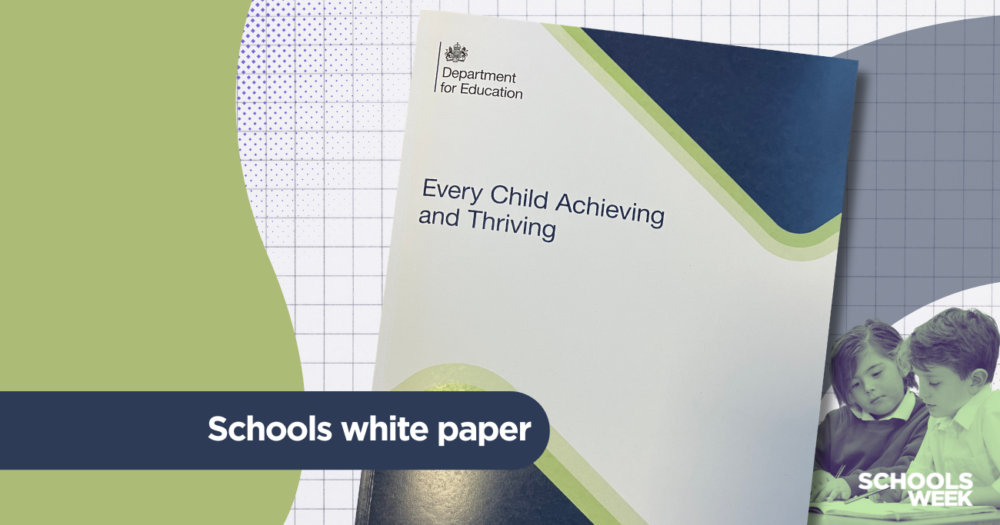
A crackdown on off-rolling pupils, a call for standalone schools to join or form MATs and changes to the admissions code are among major plans unveiled in today’s schools white paper.
Bridget Phillipson’s 120-page document “sets out a vision for education for the next decade”.
Titled Every child achieving and thriving, the white paper lays out plans to overhaul the education system with a focus on boosting attainment for all children.
Here, we’ve pulled together all the key proposals that affect schools and academies. For all the key SEND policies, click here.
1. Fair banding will need to be more transparent
Labour will consult on changes to the admissions code to “promote fairness for all families, particularly the most disadvantaged and children with additional needs” later this year.
Among the proposals are requirements for schools to give parents more information about decisions on in-year admissions. It also plans to change how fair access protocols are managed by councils but did not provide specifics.
“Finally, we are making the operation of banding arrangements clearer by requiring schools to set out more details about how their arrangements work in practice and tightening the rules that ensure banding produces representative intakes,” the white paper said.
2. Off-rolling crackdown
The government has promised to “strengthen scrutiny of all pupil movement”.
It will do this by launching a new internal dashboard that identifies school-level trends “that could suggest off-rolling or other concerning practices, including off-site direction and managed moves”.
Officials will then “follow up on a targeted basis with responsible bodies to understand and challenge where there are possible concerns”.
They will “pay particular attention to schools where SEND, free school meal or demographic trends appear significantly out of sync with their local context”.
The department will also try to share more timely pupil movement data with Ofsted to help it identify “unacceptable” practice.
Where this is unearthed, schools will likely be issued with an ‘urgent improvement’ grade. This would normally lead to intervention.
3. Standalone trusts ‘challenged’ to defragment system
The government wants all schools to join or form trusts. Councils and local area partnerships will also be given the power to launch their own chains.
To help manage potential conflicts of interest, restrictions on local authority involvement in the day-to-day running of their trusts will be introduced.
Pointing to the number of single-academy trusts in deficit, the document posed a “challenge to our best standalone schools” to partner with others and make the system less fragmented.
Recognising the role local authorities play in “safeguarding, supporting and promoting the welfare of all children in their area”, ministers will also “strengthen and clarify” how they should work with academy chains.
4. More big trusts?
The government will prioritise “quality over pace” when moving schools into trusts.
It will welcome those “taking steps to meet the aspirations set out in this white paper, from embedding inclusion to tackling the attainment gap”.
It noted there will be “a degree of flexibility on size… to reflect the different characteristics of local school landscapes”.
The government has not set a deadline for all schools to be in trusts, nor said whether any high-performing schools will be forced to participate.
5. Trusts judged on community work
Trust commissioning guidance will be updated. Among other things, a new “pillar focused on community collaboration” will be added.
The Department for Education will encourage trusts to provide updates on “how they have supported stronger outcomes in their community role through annual public benefit reporting”. They will be held to account on this through MAT inspections.
It will also consult on requiring trusts to have governance structures that “include all their schools, hold annual parental forums, and ensure boards hear directly from parents and school communities”.
6. MAT inspections to cut school visits?
Ofsted has previously announced it will introduce trust inspections. The white paper said the checks will focus on “assessing quality, rather than checking for compliance” and prescribing certain approaches.
The government hopes the checks will “reduce the burden of school-level inspection”.
Schools will be able to be transferred out of underperforming trusts. Ministers will “also explore using existing provisions to require an underperforming trust to strengthen its governance or engage with external support”.
7. Pooling transparency
The white paper added that the pooling of trusts’ resources “can unlock innovation and maximise value for pupils”.
To support this, DfE will “improve arrangements for transparency where resources are being pooled and illustrate where this is being done effectively”.
Among other things, this will offer parents and communities greater clarity, the document said.
8. ‘Excessive’ CEO pay clampdown
On the controversial issue of trust CEO pay, the government said some academy chains have signed off on “high salaries”.
It vowed to “tighten” rules in the academy trust handbook by requiring wage hikes to be “proportionate and justified”. It hopes this will “prevent excessive increases for individuals carrying out broadly similar roles”.
9. ‘Essential’ local partnerships
The white paper argued it is “only through collaboration between all the local services that touch on a child’s life that we can expect to deliver the improvements we want to see”. But until now this “has been seen as optional rather than essential”.
The government plans to create a new model of local partnership and shared accountability that binds the likes of councils, schools, integrated care boards and police “around the aim of delivering shared outcomes for children”.
10. Funded work with early years
To support children’s transition into reception, the government will “fund partnerships between early years settings and schools”.
Staff from both settings will be expected to spend time with each other and share knowledge.
The government will “publish and share best practice… from schools that effectively support children into reception”.
11. RISE KS3 alliance
The white paper noted the transition from primary into secondary remains difficult for too many children. To improve this, it will launch a key stage 3 alliance.
It will help schools to collaborate on issues including the critical transition from primary, teaching and curriculum, attendance, and strengthening data at KS3.
This will be overseen by the DfE’s RISE improvement teams.
12. National blueprints
As part of its work to tackle entrenched disadvantage, the government will launch two place-focused schemes, called mission north east and mission coastal.
The former will “focus explicitly on radically improving outcomes for white working-class children”. The other mission will focus on disadvantaged coastal communities.
The programmes will bring together schools facing similar challenges and develop strategies for improvement.
The DfE hopes they will provide a “blueprint for change nationally”.
13. Attendance targets
The government has set the sector the target of improving attendance to over 94 per cent. This is 1.3 percentage points over levels seen in 2023-24.
Officials estimated this would equate to children attending 20 million more days of school each year from 2028-29.
14. Reintegration after suspensions
Guidance on behaviour in schools will also be updated. So-called reintegration support partnerships will be launched, too.
They will involve a formal meeting between parents and schools following a suspension “leading to an agreed plan and responsibilities”.
“Schools that already do this well use these meetings to bring together schools, families, and relevant parties to co-develop strategies focused on collective responsibility for early intervention and behaviour improvement,” the white paper said.
The DfE will consult on a proposed model and “provide supporting good practice resources and case studies as part of the refreshed statutory suspension and permanent exclusion guidance”.
15. Ofsted to assess enrichment from autumn
The DfE has already announced plans for new enrichment benchmarks which schools will be judged on by Ofsted.
The white paper reveals an enrichment framework will be published this academic year, setting out benchmarks “on what good enrichment looks like”. Ofsted’s inspection toolkits will then be updated in September, to take account of these benchmarks.
16. Reforms to be ‘carefully sequenced’
The reforms set out in the white paper are wide-ranging.
Schools will be given a minimum lead-in time to roll out any relevant changes. The DfE will work with the sector to assess what timeframe should be given for various changes.
Reforms will also be rolled out in “a sequenced, phased and manageable way”.
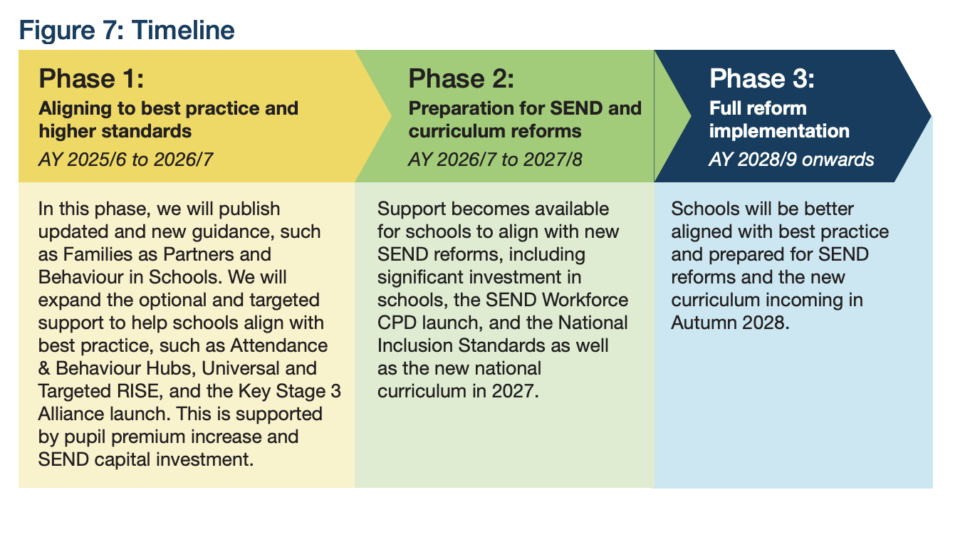
Implementation will come in three overlapping phases: “aligning to best practice” from 2025-26, preparing for SEND and curriculum reforms from 2026-27, and “full implementation” from 2028-29.
17. New model for measuring disadvantage
The white paper confirms the government plans to “develop and test a new model for targeting disadvantage funding”.
As revealed by Schools Week, government is specifically looking at using income data, rather than the “binary metric” of free school meals eligibility, to assess which pupils attract extra funding, the white paper said.
It added that a “stepped model” could “take into account how low family income is, and for how long this has been the case”.
The government is also considering whether to target funding “based on the place
a child lives, as well as their individual family economic circumstances”.
A consultation will be held this summer.
18. Struggling schools to get help with pupil premium strategies
New pupil premium strategy reviews will be held for schools needing extra support with helping disadvantaged pupils.
The white paper said the government-funded reviews would be delivered by “sector experts”, giving “tailored advice to help schools plan, implement and evaluate improvements to their pupil premium strategy”.
It does not say how schools will be deemed eligible.
19. Pupil engagement framework to be drawn up…
A new pupil engagement framework is to be developed, with help from pupils, parents and schools. When published later this year, it will allow all schools to measure “the key factors” that determine pupils’ engagement in eduction, and make improvements.
“By 2029, we expect every school to monitor pupils’ sense of belonging and engagement”, the white paper said. Currently around 60 per cent of schools report they measure factors around this.
20. …and parental engagement guidance
The government also plans to design “minimum expectations on parental engagement”.
The principles will “make clear what families can expect from schools, and what
schools will expect of families in return”. It will aim to increase consistency around relationships between schools and parents and create “a strong school culture”.
21. New way of handling parent complaints
The government will create “a new digital, accessible solution for handling complaints” to simplify the process, and improve coordination and data collection.
It comes as analysis shows there has been a huge recent rise in parental complaints to schools.
The DfE will also set out “mutual expectations” for handling complaints, including “clear and consistent timeframes for resolving complaints, to help schools with managing expectations while ensuring that families feel reassured”, the white paper said.
22. National monitoring of abuse of teachers
Assaults on school staff “are rare but rising, and totally unacceptable”, the white paper said, so the government plans to improve the way abuse of school staff is monitored.
It will support the sector to collect “more thorough and consistent” reporting of incidents, and “consider the case for national monitoring”.
23. 6.5k pledge plan detailed
A much-awaited document published alongside the white paper also detailed how progress on the government’s pledge to boost secondary, special school and college teacher numbers by 6,500.
It detailed strategies to boost recruitment and retention. Among these is “exploring” how the future high potential initial teacher training scheme – run by Teach First – could be expanded to FE colleges.
Flexible working will be promoted through its RISE programme, especially for returning mothers. The white paper also sets out plans for improved maternity pay for teachers.
24. Plans to boost teacher retention
The white paper also said a new teacher retention programme will launch in the autumn.
It will see best practice on flexible working shared across the sector, and “provide peer support, coaching and resources” so schools “learn from each other on managing workloads and expanding flexible working”.
25. One-stop shop for school support
The white paper laid out plans to “build a new one-stop-shop digital platform for schools”. It will signpost “quality-assured support to empower smart investment in data-driven, evidence-led self-improvement”.
It will help diagnose schools’ strengths and weaknesses, and allow them to benchmark their performance against similar institutions.
It will also help leaders “navigate towards high‑quality, trusted support” from high-performing schools and trusts, commercial programmes and RISE hubs.
26. Work with EEF
DfE will work with the Education Endowment Foundation – which is run by Becky Francis, who led the recent curriculum review – so more schools can access its “high-quality research on what works to improve academic progress and attainment”.
To help with this, the department will also support networks and organise conferences.
27. Call to action
The white paper also issued a “call to action for the sector” asking the “best” leaders to step forward “with their ideas to innovate across a range of new areas”.
It is hoped this will amplify the impact of leaders’ work and “give them the platform from which to lead”. Officials have not defined what this support will look like as they want the sector to shape it.
But they want it to focus “big system challenges that reflect the core themes of this white paper”, like the barriers preventing pupils with SEND or from poorer backgrounds from accessing enrichment opportunities.
28. AI safety and quality standards
The DfE is working with the sector to build “clear principles” on the use of AI in schools.
It will develop “sovereign education benchmarks to assess the safety and pedagogy of AI in education”, by working with “a taskforce of educational experts”.
This will “firmly guide technology companies” to create tech that supports children’s outcomes .
29. Focus on ‘excellence in leadership’
The white paper lays out a targeted package of interventions for “excellence in leadership”.
As part of this, the government said it will review the Headteachers’ Standards to make sure they “reflect key expectations”, and capture and share examples of best practice.
It has also pledged an extra £500,000 a year for improved early headship coaching, which the government said will reach around 500 more heads, particularly from disadvantaged areas.
Newly appointed headteachers will also be offered retention payments of up to £15,000 to work in certain areas under a planned pilot. The pilot will begin next year, and aims to help heads “stay in the areas that need them most”.
30. In-person training for SBPs
A new regional in-person training offer will be rolled out for school business professionals (SBPs), to help equip chief financial officers and school business managers “with the knowledge, skills and tools” to help “drive best value”.
31. ‘Data spine’ to be created
The government wants school information to “flow seamlessly” so insights can go directly to teachers, leaders and parents and not be “locked within individual systems”.
To deliver this, it will develop a so-called “data spine” that will provide a “secure, privacy-respecting and streamlined way to connect and share information across different systems in education”.
This will include pupil records, attendance, progress and assessments figures.










Your thoughts