

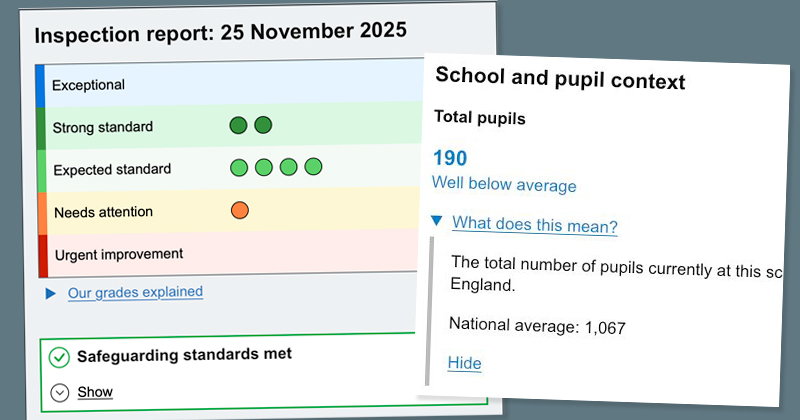
Ofsted is considering removing national data comparators for special schools from its report cards, following concerns that labelling them “well below average” for pupil numbers could confuse and mislead parents.
The report cards provide contextual data about schools to parents, but for metrics like school capacity and pupil demographics Ofsted compares special schools to mainstream schools within the same age phase.
For instance, the report for Rotherham-based The Willows School shows 100 per cent of pupils have EHCPs. But it is unusual for pupils to attend a special school without a plan.
Yet the report card claimed this is “well above” a national average of 3.1 per cent.

Special schools tend to be considerably smaller than mainstream schools, especially at secondary phase. Analysis of government data shows that an average state special school has 156 pupils.
But the report card for The Willows, part of the Nexus academy trust, claimed its 190-pupil school is “well below” an average of 1,067, which relates to secondary schools overall, including mainstream.
Nexus chief executive Warren Carratt wrote to Ofsted during the fact-checking process post-inspection about this “unhelpful and misleading” issue. “We should be compared to the special school average,” he said.
While the inspectors understood the school’s context, the issue lies in the published report card, he added.
“It’s frustrating that something that was supposed to be about more transparency and simplicity for families will now confuse them further.”
‘Room for improvement’
Steve Rollett, Confederation of School Trusts deputy chief executive, said: “This is an area where there is room for the report cards to be improved.
“Things like proportion of EHCPs and pupil numbers will clearly be quite different for specialist provision, and so, while the current phase-wide comparisons on report cards may be technically correct, they are perhaps of limited use to parents in these cases.”
Schools Week flagged the issue with Ofsted this week, questioning its approach.
In response, Ofsted said it will “review what data is included in the report cards from published sources, including potentially removing national comparators for special schools”.
The watchdog said: “We include this data in report cards to mirror the published DfE data available to inspectors during inspections.
“We do not generate this data, but we do ensure that our reporting of it is consistent with how it is reported elsewhere, for example on ‘compare school performance’.
Carratt said the response “assures me – and will assure other special school leaders – that Ofsted are listening and are willing to continue to make common-sense changes to the report card in these early teething phases.
“This is a much-needed change that will help families more clearly understand special schools.”
Ofsted had already excluded performance data from special school and alternative provision report cards.








Your thoughts