Skip to content

Featured

‘It’s more than just pay’: School teachers on why they are striking

Schools Week reporters spoke to striking teachers across England today to find out why they had taken industrial action.

Despite pay being a big issue, it was not the only reason teachers were striking. One teacher said working eight hours on a Sunday to get up to speed on lesson planning was “not unusual”.

Others are worried about recruitment struggles, with schools having to increasingly rely on non-specialist teachers for some shortage subjects.

And general funding shortages – meaning textbooks are “falling apart” and teachers have to pay for basic things like pens – was another big concern raised on picket lines.

Here’s what striking teachers told reporters Freddie Whittaker, Amy Walker and Tom Belger…


‘We’re having to work longer and do more’

Fiona Stuart, science teacher, Archway School, Stroud

“One of the main reasons we’re striking is because of the impact [underfunding and pay] is having on the education of students. Because there aren’t enough teachers in terms of retention and recruitment. That’s then directly affecting the education of kids.

“The recent pay rise that did go through had to be funded by schools, which again, then directly impacted on the kids because that was coming out of school budgets. I’ve been in education for 25 years, and I’ve seen the increase in workload, I’ve seen the lack of life outside the school. People are having to work longer and longer hours and are having to do more.

“And we’re often not having fully qualified members of staff. Staff are having to teach outside their specialism more and more. Again, it all leads back to the impact on the education of children.”


‘Not unusual to spend 8 hours marking on a Sunday

Jeremy Taylor, head of history, Bishop Thomas Grant school, Streatham

“It would not be unusual for me to spend the best part of seven or eight hours on a Sunday afternoon, Sunday evening marking students work – that’d be fairly standard. 

“It would not be unusual for me to be still in my office at 6.30pm on a Friday night, when the school finishes at 3.15pm because I’m trying to get Monday and Tuesday lessons all planned as head of department, I’ll be catching up with admin and paperwork.

“But there’s a bigger picture here as well, which is that schools are really struggling to recruit stuff. So when I started teaching in 1999, it was not unusual for 100 history teachers to apply for a job and you’d shortlist six.

“Now, if a history job gets advertised, you won’t even get six people applying for it, let alone six on a shortlist. You might be lucky to get a shortlist of two or three. One will get a job before the interview, one will drop out and then you’re in a position where you can’t even hold a competitive interview.”


‘I’m getting more money working in retail’

Sandrine Baker, art teacher, Bishop Thomas Grant school, Streatham

“As a newly qualified teacher, obviously I’m in the classroom by myself. It’s a lot, and especially with the whole marking and everything you don’t get – there’s just so much. And I’m going home and I’m still working. 

“I can understand why so many newly qualified teachers leave. I’m a very resilient person, and very well supported in my department. If you didn’t have that, I could have left too.

“I know some of my ECT [early career teacher] cohort from other schools in Birmingham, the level of stress they’re under, some of them are still considering [the job] because they’ve done part-time jobs in retail before and they were like ‘I’m getting more money doing retail’.”


‘It’s hard to do a hard job when you’re also worrying about money’

Antonia Debbonaire (left), primary school teacher, Bristol 

“The pay rise is coming out of schools’ budgets so it’s squeezing schools even further. And it’s not in line with inflation, so it’s not a pay rise, it’s a pay cut, and it’s really affecting lots of teachers.

“Teachers are using food banks. And it’s really hard to do a really hard job when you’re worrying about money and how you’re going to survive and all of that. So there needs to be some respect given to teachers and dignity. We should be paid properly. 

“Lots of people are struggling, and we’re seeing it with the children that we teach and we’re not being able to give them what they need.”


‘We’re using textbooks that are falling apart’

Alyson Knight, maths teacher, Archway School, Stroud

“We’re using textbooks that are falling apart, and you can’t attract people into the profession anymore. So that means we can’t get specialist teachers into the department, and that creates problems particularly for the children.

“There’s a reason why teachers aren’t coming into the profession, and they’re not staying there. People forget it’s actually quite strenuous teaching 32 15 to 16-year-olds.

“And it’s not just about teaching a subject. It’s about helping them with their special needs, their anxiety, making sure you’re doing it at different levels. And yet your pay isn’t reflecting that.

“And people are coming out of university and looking at teaching or something else, where they can earn half as much again, get private health insurance, and don’t need to drive to work.”


‘I’m having to buy basic things like pens for pupils’

Sam Davis, (pictured left), textiles teacher, Bishop Thomas Grant, Streatham

“Me and my colleague art teachers are actually buying materials regularly, so that we can give kids what they need.

“I’m a textiles teacher so it’s fabric or buying threads. I’m buying pens. It’s just absolutely basic things that we do not have the funding for.

“A lot of people might say we only work so many weeks a year and we have so many hours a day, but the reality is that we’re taking work home with us or we’re staying late.

“I think what all of these strikes are raising is that there is something that has gone fundamentally wrong with the way things are being funded generally. And the cost-of-living crisis is real and it is affecting people’s lives. It’s affecting people across the board.”


‘Using non-specialist teachers is short-changing kids’

Mark Richards, history teacher, Archway School, Stroud

“My biggest concern is recruitment of young teachers. Also, the scarcity of new science teachers and maths teachers is a big concern, because a lot of non-specialist teachers are teaching maths and science, which is definitely short-changing the kids.”


‘We need to retain staff and make sure no services are lost’

Daniel Hapgood (right), maths teacher in Greenford, west London

“For me it’s about pay to retain staff and making sure no services are lost – the offer is unfunded so schools are reducing them.

“You can see those most worried about losing pay striking are ECTs – they’re most likely to leave. That’s a huge issue, and about workload too. I’m thinking about future year groups, not just current ones.”

Featured

Zahawi: I’ll put children and families at centre of ‘building back better’

New education Secretary Nadhim Zahawi has signaled that children and their families will be the focus of his new drive to “build back better”.

In his first statement since replacing axed Gavin Williamson today, Zahawi said children have had a “tough time” during the pandemic.

The former children’s minister added: “I’ll be listening to them and their families as we accelerate our work to build back better and fairer.”

Children’s commissioner Dame Rachel de Souza met Zahawi this evening, tweeting that his first words were about his “absolute commitment to looked after children and to deliver for vulnerable children”.

In his statement, Zahawi said education was a “crucial part” of the government’s levelling up agenda, adding it was an “honour” to be back at the Department for Education.


History maker: 12 facts about the new education secretary

Zahawi profile: ‘I was the quietest boy in the class — the teachers thought I had learning difficulties’

Axed: Williamson sacked as education secretary


The MP for Stratford-upon-Avon served as children’s minister from January 2018 to July 2019, and was apprenticeships adviser to Downing Street during the Coalition years.

Zahawi, who fled Iraq to come to the UK when he was nine, added: “From my own experience, I know what a beacon of opportunity this country can be and I want all children, young people and adults to have access to a brilliant education, the right qualifications and opportunities to secure good jobs.

“That’s both vital for them and also our economy and is more important now than ever before.

“I can’t wait to get started, working with the amazing teachers and staff in our nurseries, schools, colleges and universities as well as employers and businesses.”

Featured

DfE denies ‘achieving excellence areas’ policy has been delayed

The government has denied its ambitious plans to provide extra support for schools in struggling areas have been delayed while Theresa May considers whether to lift a ban on grammar schools.

Achieving excellence areas was a key policy unveiled in the recent white paper that pledged to inject extra cash and support into priority areas identified as having low standards and poor capacity to improve.

Schools Week has previously reported how the pilot was due to start in September.

But the Times newspaper claimed yesterday the Department for Education (DfE) had delayed announcing which areas would receive extra cash – due before parliament broke up for the summer recess.

The newspaper attributed this to the government’s plan to lift a ban on new grammar schools, with a Whitehall source claiming talk of excellence areas had “all gone quiet”, adding: “There is concern it will not now go ahead”.

But the DfE has today denied there was any delay, stating an announcement on the scheme is due “shortly”.

“It is simply untrue to say that this policy has been delayed because of speculation about grammar schools – work on the achieving excellence areas is entirely separate.” Robert-Hill

Robert Hill (pictured right), an education consultant and former government adviser, described the policy idea as one of the best white paper proposals, and said the alleged delay was “concerning”.

But he told Schools Week it is understandable if Justine Greening, the new education secretary, is taking her time before making any policy announcements until she fully understands the brief.

He added: “If the delay continued into the autumn then that would signal more worry.”

Hill said the run up to the first week of autumn term is usually earmarked for policy implementations and announcements, adding Greening could be waiting until then before making any major decisions.

The government said its achieving excellence areas policy would target “pockets of underperformance” across England where the school-led system was “not yet mature enough” to address issues, and committed to eradicating those issues in the next five years.

It pledged not to establish new “top-down initiatives or bureaucratic action plans”, but instead said it would target schemes to ensure “sufficient high quality teachers, leaders, system leaders, sponsors and members of governing boards on these areas of greatest need, starting with the National Teaching Service”.

The DfE had previously released a methodology showing that parts of the north east, along with segments of Cambridgeshire, Norfolk and the East Midlands and the East Riding of Yorkshire had been in line for extra support (map below).

But a Whitehall source told Schools Week it is not just the achieving excellence plans that are on hold while Greening gets up to speed.

“It’s not because of grammar schools per se, it’s that the new government wants to make sure it’s happy with everything now planned out of the department, and that it takes account of any changes in direction.”

Hill also said the alleged delay does nothing to rule out that the white paper could have significant changes if there is a “new education strategy”.

map12
Click picture for larger image


Big Education’s merger with Oasis given go-ahead

High-profile academy merger plans for a pioneering three-school trust in London to join one of England’s biggest MATs have been given the official go-ahead.

Schools Week revealed in November that Big Education Trust was set to consult on proposals to team up with Oasis Community Learning, which runs 55 schools across the country.

This morning, the organisations announced they received the green light from the Department for Education for the merger to happen later this year.

Boosting ‘offer to every child’

Oasis CEO John Barneby believes it will strengthen what his trust “can offer to every pupil, in every community” it serves.

“Oasis has always been clear that education sits within a wider set of relationships — with families, communities and the bright futures young people go on to lead,” he said.

“Big Education brings an exceptional, evidence-informed approach to that work, built over many years through their schools and programmes.”

Big Education was launched in 2018 by current CEO Liz Robinson and Peter Hyman. Hyman is a former adviser to Tony Blair and more recently to Keir Starmer in opposition.

Its academies include Surrey Square Primary, which hasn’t permanently excluded a pupil in almost two decades, and School 21, a free school torchbearer for progressive values that was co-founded by Hyman and Oli de Botton, who is now the prime minister’s education adviser.

Scaling Big’s work

Big Education chief Liz Robinson said the move will help her trust “grow an approach to education that we know makes a real difference – one that goes beyond academic outcomes and focuses on the whole child”.

She added: “Our model has been developed and tested through our schools and professional programmes, and the evidence of its impact is clear.

“Joining with Oasis gives us the opportunity to scale that work, while protecting what makes it distinctive.”

Speaking last year, Robinson said her trust decided to merge three years ago as “three schools is too small to run a MAT”. The Oasis connection came after she met Barneby at an event in 2024.

While Oasis was “not actively pursuing growth”, Barneby said his “ears pricked up” when he realised the trusts shared the view that “there is more value to education than just exam results. They’re really important, they’re a key aspect, but education does a lot more than that…beyond the headlines.”

DfE’s merger ‘interest’

He also said the DfE was taking an “interest” in the move, with officials identifying the “operational scale and efficiencies” it could bring.

At the time, Barneby could not rule out redundancies but said the goal is to “preserve the nature and character” of Big Education.

Today, the MATs said the government’s decision followed “a period of consultation with staff and stakeholders, whose valued feedback has informed the approach and will continue to play an important role as the two trusts prepare for the next phase of their shared journey”.

It is expected Robinson will move into a new role focused on “growing” her organisation’s projects across Oasis.

The merger is set to be completed in September.

Only four other trusts will have more schools on their books – United Learning, REAch2, Delta Academies Trust and St Gabriel the Archangel Catholic MAT.

DfE set to make school phone ban guidance statutory

The Department for Education is set to introduce a statutory mobile phone ban in schools, to give “legal force to what schools are already doing”.

Skills minister Jacqui Smith told the Lords last night the government will issue an amendment to the children’s wellbeing and schools bill to put existing guidance on a statutory footing.

This will mean the guidance “must be followed unless there is a legally justifiable reason for schools not to do so”, she said.

Research by the children’s commissioner, Rachel de Souza, found last year that 90 per cent of secondary schools and 99.8 per cent of primary schools already have policies in place that stop the use of mobile phones during the school day.

A DfE spokesperson said the amendment will give “legal force to what schools are already doing in practice”.

“It builds on the steps we’ve already taken to strengthen enforcement, with Ofsted considering schools’ mobile phone policies as part of inspection from this month.”

It comes days after early years minister Olivia Bailey told the Commons that government had “already solved the problem of banning phones in schools”.

The government is currently consulting on technology and its impact on children, including whether the school phone guidance should be made statutory.

‘Doesn’t change much’

Pepe Di’Iasio, general secretary at ASCL school leaders union, said a statutory ban “doesn’t really change much”.

“Most schools already have policies in place under which pupils are not permitted to use mobile phones.

“The most common approach is to require them to keep devices ‘off and away’ during the school day – with the challenge then being to ensure that these rules are followed.

“What would really be helpful is for the government to make funding available to schools for the safe and secure storage of mobile phones, such as storage lockers or locked pouches.”

Paul Whiteman, general secretary of school leaders’ union NAHT, said statutory guidance “will give school leaders the clarity they need to implement a ban, and will remove any ambiguity or differences between how schools approach smartphone policies.

“Schools will only then need to decide how to implement and enforce a ban across their school community and the government must provide any support they require to do so effectively.

“Some schools will need time to communicate with parents and pupils on implementation of a complete ban where this is not already in place.”

Further details on the amendment have not been published, but are expected when the bill is debated in the Commons on Wednesday.

Academy bosses’ salaries are on the way up, but women are missing out at the top

Almost 100 academy trust bosses are paid eye-watering salaries of more than £200,000, prompting calls from governors for an NHS-style executive pay framework.

Schools Week’s annual investigation into chief executive pay – which analysed almost 1,100 trusts – also found 90 per cent of those above the £200,000 threshold were given rises and that six trust chiefs were paid more than £300,000 last year.

Only a quarter of the top earners were women.

Sam Henson, the deputy chief executive of the National Governance Association, said the findings reflected a “stubbornly entrenched” gender pay gap at the top, and a “widening disparity” between the earnings of CEOs and their workforces.

“That is not just an optics problem but a bigger, as yet unanswered question lurking over the sector – does the current approach to MAT exec pay really reflect the values of equity and organisational culture we need it to reflect?

“I think the answer is no. Both boards and executives should be asking what their own pay trajectories signal to the teachers and support staff on whom every trust depends.”

The £300,000 club grows

There are now six members of the £300,000 club, according to our analysis, up from four last year.

Harris Federation’s Dan Moynihan topped the pay charts – as he has done since Schools Week started its annual audit.

He earned between £530,000 and £535,000 in 2024-25 following a £15,000 rise. He is the only leader to earn more than £400,000.

Dan Moynihan

Moynihan was followed by Leigh Academies’ Simon Beamish and Brampton Manor’s Dayo Olukoshi. They received at least £380,000 and £350,000 respectively.

Accounts for the Nicholas Postgate Catholic Academy Trust suggest Hugh Hegarty, its former chief executive, pocketed between £320,000 and £330,000 last year, an increase of £105,000 (49 per cent). All trusts were approached for comment.

In all, 88 trusts paid their chief executives more than £200,000 last year, 24 more than 12 months earlier. On average they each had 17 schools on their books.

Analysis by the Kreston group of accountancy firms earlier this year showed the average salary of an executive running large MATs – those with more than 7,500 pupils – crossed the £200,000 mark “for the first time”.

Those in the biggest chains received an 8.2 per cent hike.

But Kreston noted the “overall movement and range” in pay across all trust types was “not significantly different to previous years”.

Our investigation found 27 (31 per cent) of the trusts paying their executives more than £200,000 had 10 schools or fewer, broadly in line with 12 months ago.

Single-academy trusts

Four were single-academy trusts (SATs). The Flagship Learning Trust was again the highest-paying SAT, with Martin Haworth making between £280,000 and £285,000.

Trust accounts said he “voluntarily rejected an incremental increase to his pay”.

However, a “cost-of-living increase was applied in accordance with the national school teachers’ review body report”. Flagship declined to comment.

At the Carlton Academy Trust, which has eight academies, Adrian Kneeshaw was paid £285,000, up £25,000 on 12 months earlier.

A spokesperson said the figure had been “distorted” as it “contains remuneration for external consultancy and school improvement work” and he had a higher basic wage because he did not belong to the Teachers Pension Scheme.

The “true” number “would be below £200,000”, which was “excellent value considering the high degrees of deprivation facing our schools and outstanding financial and academic performance of the trust”.

Ninety per cent of the trust chiefs on more than £200,000 received pay rises.

Just 27 per cent were women, up from 22 per cent the year before. All members of the £300,000 club were men.

Will Jordan, the founder of finance firm IMP Software, said his analysis of more than 400 MATs showed “male and female leaders in comparable roles are paid at broadly similar levels”. But there was a “clear gap in who gets to lead the largest trusts”.

“Among CEOs, women hold 59 per cent of roles at the smallest trusts but just 25 per cent at the largest.

“The pay picture is encouraging, but the representation data raises a question the sector should be asking: why does the proportion of women in senior leadership fall as trusts get larger?”

‘Follow the NHS’

Henson urged the government to explore a “framework that by definition builds in limitations as well as progressions”. Its introduction “is now more than compelling”.

“The NHS operates a very senior managers’ pay framework, banded by organisational size, with clear thresholds and central approval above them.

“It isn’t a perfect model, and any equivalent for academy trusts would need to be carefully and distinctly designed. But the principle is sound.”

The pay of some trust leaders did fall last year.

Estelle Macdonald, of the Hull Collaborative Academy Trust (HCAT), was paid a maximum of £170,000, having previously earned up to £250,000.

This is the least she has been paid since 2019. The trust was approached for comment.

The pay of high-profile leader Tom Rees, of the 45-school Ormiston trust, fell slightly from £202,000 to just under £199,000. Over the financial year, he was named a government tsar to oversee reforms to make mainstream schools more inclusive.

It was also announced last month that he will co-chair an expert panel to develop packages underpinning education, health and care plan reforms and new national inclusion standards. Ormiston was approached for comment.

‘Enormous’ pay packets

Excessive trust pay has come under renewed criticism, with the Green Party’s Zack Polanski warning at the National Education Union conference last month of a “fragmented system with poor accountability, allowing academy CEOs to be paid enormous salaries”.

Just a few days later, Matt Wrack, the general secretary of the NASUWT teaching union, attacked chief executives making more than £250,000 a year, “significantly more than the prime minister”.

He claimed some were sitting “atop ‘empty’ academy trusts, claiming large salaries while managing relatively low numbers of pupils”.

Others were “presiding over trusts failing so heinously that we are stepping in to protect teachers and pupils through industrial action”.

Average pay across the 1,084 trusts we analysed stood at £142,000, compared with £135,000 the year before.

Leora Cruddas, of the Confederation of School Trusts (CST), noted the “median pay for a secondary headteacher last year was £117,601 and the top of the maintained school pay range for heads is £153,490”.

“In that context, an average CEO pay of £142,000 indicates that trust boards are taking seriously their duty to set pay that is appropriate, and that reflects the size and complexity of each individual trust.”

Leora Cruddas
Leora Cruddas

Greater trust focus

In its schools white paper, released two months ago, the government said some academy chains had signed off on “high salaries”.

It vowed to “tighten” rules in the academy trust handbook by requiring wage hikes to be “proportionate and justified”. It hoped this would “prevent excessive increases for individuals carrying out broadly similar roles”.

Ministers had already tightened rules to ensure the whole trust board – rather than smaller committees of trustees – agreed executive pay.

Sharon O’Ryan, of salary advisers Pay in Education, said the changes had resulted in trusts focusing “more on the processes for determining executive pay and for managing pay progression”.

In particular, they had been “documenting evidence around their decision-making, as well as benchmarking the salaries to avoid becoming outliers. And if they are, they document the rationale and provide evidence to support why that may be the case.”

Secret pay crackdowns

The government’s last CEO clampdown, published in 2024, named and shamed the 37 leaders it previously wrote to over their pay in 2021-22. All the trusts were “found to be compliant”.

Twenty-eight have bumped up their chief executive’s pay since being quizzed by officials, our analysis suggests.

Through freedom of information, the DfE said it has since conducted two more clampdowns, based on figures from 2022-23 and 2023-24.

However, officials would not disclose which trusts it wrote to, or the methodology it used to identify the outliers, as it intended to publish the details “before the end of the current academic year”.

37 trusts named and shamed in new ‘outlier’ CEO pay crackdown

While the DfE has published information on academy executive pay, it hasn’t published similar information on local authority-maintained schools – even though it collects this data.

When asked for the earnings of the 10 highest earners in council-run schools, officials said that sharing the information would “contravene a number of the data protection principles” and “would be regarded as ‘unfair'”.

This is despite maintained schools having to publish the salary bands of employees earning over £100,000 on their websites.

Three-quarters raise pay

Across the 1,084 trusts we analysed, executive salaries rose in 798 (74 per cent).

The St Oscar Romero Catholic Academy Trust handed out a £140,000 increase, with David Garrido, who resigned last June, given a minimum of £250,000. The trust was approached for comment.

Pepe Di’Iasio of the Association of School and College Leaders said the findings suggested “a mixed landscape, which is to be expected with there being no national framework for CEO pay and decisions being left to individual trusts”.
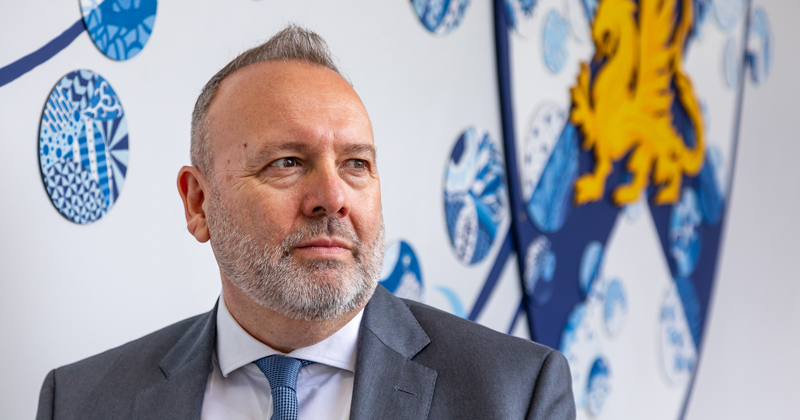
Pepe Di’Iasio

Just 9 per cent of the academy chains we analysed cut pay, with the largest drop at Telford City Technology College Trust Limited.

Kevin Satchwell, its former chief executive, earned £320,000 to £330,000 in 2023-24. But latest accounts suggest his successor, Ian Rawlings, was paid a minimum of £170,000 last year.

Di’Iasio added: “With the size, shape and context of trusts varying widely and changing all the time, leadership structures are also regularly shifting as roles and responsibilities evolve.

“When this happens, it may well be necessary to adjust salaries accordingly. In times of tight financial constraints, the most important thing is that trust boards are able to demonstrate good value for money.”

£200,000 outliers

Our outlier analysis – which calculated the expected pay for leaders based on pupil numbers – showed 22 per cent paid their chief executives at 15 per cent or more over expected levels. This is broadly in line with last year’s figure (23 per cent).

Once again the biggest outlier was Brampton Manor, which runs two Newham schools in east London. The analysis suggested a trust of its size would usually pay its leader about £148,000, more than £200,000 less than Olukoshi received.

The New Vision Trust was one of four that paid its leader more than double expected levels. Shahed Ahmed, its chief executive, said the five-school chain “commissioned an independent salary assessment” when it was formed in 2018.

Since then, it had “increased by no more than the annual national pay award for teachers”. He was also responsible for “functions that [would] be typically carried out by a wider team in other trusts” and oversaw maths and English hubs.

Twenty-four per cent were paid at least 15 per cent less than expected levels, down from 27 per cent the year before.

Despite this, Kreston analysis suggested leadership costs grew more slowly than overall staff costs per pupil in MATs. In the largest chains, the gap was over 15 per cent.

“For all the hyperbole that accompanies headlines around CEO salaries, the data suggests that large MATs are significantly out-performing other trusts when it comes to the cost of leadership,” Kreston said.

‘Careful balance’

Unsurprisingly, those in the bottom five for pay per pupil were among the country’s biggest trusts. The smallest MAT of them oversaw 39 schools.

The lowest-paid leader by pupil was again Jon Coles, of United Learning, who earned £4.68 for every child across his 92 schools. Our outlier data suggested he should have been paid £506,000.

Oasis Community Learning’s John Barneby also featured in the bottom three.

An Oasis spokesperson said its “approach to remuneration reflects a careful balance between attracting the experienced leadership required to run a large and complex trust, and staying true to our values of equity, justice and responsible stewardship”.

Our figures suggest Amanda Nicholson, of the Kings Academy Trust in Manchester, was the best-paid trust boss per pupil (£313.65). Three of the five schools her organisation ran last year were either special or AP settings.

Nicholson stressed hers “isn’t an average CEO role or salary” as she was drafted in to launch the trust and introduce “all the checks and balances”. It was also “deliberately taking on failing schools that [councils] have had serious difficulty with”

“Budgets have gone from £3 million to £20 million per year. The stress is unbelievable.

“The salary I am paid on is just for me and me alone, and I retire in three years. So, it is time limited. The salary scale that has been set for my successor is in the £120,000 [to] £130,000 range.”

Pay gap

Our analysis also suggests the gap is continuing to widen between CEOs and their number twos in the highest-paying trusts.

This grew in 55 (63 per cent) of the 88 paying more than £200,000. It narrowed in 19 (22 per cent).

Henson argued that continued sector growth without a “principled pay structure “is neither sustainable nor governable, and it ultimately undermines confidence in the system that MAT leaders are working hard to build”.

“Boards have both the right and the responsibility to set competitive executive pay, and significant, attractive pay is entirely justified given the complexity and accountability of many of these roles. But ‘reasonable’ needs a reference point and the sector doesn’t yet have one.”

Teachers’ pensions delays ‘unacceptable’, says minister

Delays in the administration of teachers’ pensions are “unacceptable”, the schools minister has said, as a union called on the government to “step in”.

Problems with the Teachers’ Pension Scheme (TPS) have received renewed national attention after MPs heard about similar issues with civil service pensions. Both are run by the outsourcing giant Capita.

Tens of thousands of retired teachers are still waiting for statements telling them how much they could be owed following public sector pension reforms in the 2010s.

The McCloud remedy came after a 2018 court judgment ruled “transitional protection” reforms three years earlier had treated younger workers unfairly.

Freedom of information requests have revealed tens of thousands of retired teachers are still awaiting remediable service statements (RSS), telling them how much they are owed and asking them to choose between a legacy scheme or a reformed option.

‘Complex change’

Speaking to Schools Week on Wednesday, schools minister Georgia Gould said the McCloud judgment “was a massive, big, complex change, and there are delays in complex cases. It’s unacceptable for teachers.”

“I know how tough it is,” she added, saying she had received many letters from teachers and was “carefully monitoring” the situation. “We’re putting more resources in to support it.”

Georgia Gould

Schools Week has revealed how some retired teachers have died before receiving their statements, while many others are in ill health.

At the National Education Union’s conference last month, Liverpool joint secretary Graham Copsey described the TPS as “a mess”.

“It’s not fit for purpose. It’s failing teachers.”

Beneath posts on TPS social media pages, dozens of frustrated former teachers beg for updates and describe the difficulties they are facing.

Katina McCormick retired in 2018 and has been waiting three years for her RSS.

“It’s just horrendous,” she told Schools Week. “I get days where it really won’t go out of my head. I don’t want to be one of those that dies before I get it.

“Whether it’s £1,000 or whatever, I need it and I’m entitled to it. I’m not in the best of health. I don’t need the stress.”

Union demands action on pensions

Kate Atkinson, the national secretary for the school leaders’ union NAHT, called on the DfE and Capita to “take urgent, transparent action” to clear the backlog.

“Thousands of dedicated professionals, who have spent their lives shaping the future of our children, are now being left in financial limbo at the very moment they should be able to plan their retirement or financial futures with confidence.”

She said members who contacted  TPS reported “waiting for hours on the phone, or weeks for email responses and … often don’t get the help they need”.

She had tried to contact TPS herself. “You are number 48 in the queue, then you get cut off before you get through. It is so frustrating.”

Atkinson said the DfE, as manager of the scheme, “must step in”.

“Teachers deserve a pension system that works – and right now, it isn’t working.”

“We are urging the government to act now. These issues are causing real harm to real people – and they will not be solved by waiting and hoping for improvement.”

Other pensions affected

The delays to teachers’ pensions statements can have huge ramifications for other elements of members’ finances – and other pension schemes.

Pank Patel, the former regional schools commissioner for the West Midlands, told Schools Week the issue with teachers’ pensions meant he was unable to access his civil servant’s pension.

Pank Patel

Having also served as a headteacher and academy leader, he retired five years ago and has been drawing his teacher’s pension.

Now 60, he wants to access his civil service pension. But he must first obtain a transitional tax-free amount certificate (TTFAC) from the TPS, which cannot be issued until he has received and returned his RSS.

Patel applied for his TTFAC in December and has since contacted the TPS and DfE repeatedly asking for a timeframe, but none has been given.

He said he wants to access his lump sum so he can help his daughter get on the property ladder and ease his son’s “crippling” student loan.

“We would desperately like to help our children, but we just can’t,” he said. “That’s the one pot of money I had set aside to access at 60, and I can’t have it.”

‘Stress and anxiety’

Patel has complained repeatedly, but has been left deeply frustrated by a lack of firm answers or timeframe for responses.

He eventually received a response from the education secretary after his MP contacted her, but was disappointed by its contents.

Bridget Phillipson’s response, dated March 18, said: “Unfortunately, I cannot provide a timescale for when your constituent’s RSS and therefore when his TTFAC will be issued. However I can assure you that my officials have raised Mr Patel’s case with TP and are working to get this issued to him as soon as possible.”

Capita is understood to be reviewing Patel’s case.

He said a lack of any timeframe has “caused a lot of stress and anxiety”.

“I’ve got a pension that is just sitting there and I can’t access a single penny of it. I’ve hit a complete block.”

No deadline in sight

Schools Week previously revealed that as of last March, 77,600 retired teachers had not yet received their McCloud remedy statements. Nearly 6,000 had died without receiving their payment.

A further FOI revealed that as of mid-November, 69,700 were still waiting. This means that between March and November, cases had been settled at a rate of 987 a month.

Clearing the backlog will not finish until September 2031 if progress continues at that rate.

To add to the chaos, the handover of the £233 million TPS contract from Capita to new provider Tata Consultancy Services, due to take place last October, has been delayed twice.

A new government contract shows the DfE is set to pay the professional services network PwC £260,000 plus VAT to “support the safe and effective transition” of TPS administration.

Gould told Schools Week the DfE was “really determined to get [the transition] right”. “We need to be absolutely assured that there is going to be no issues for teachers, so we will take that very carefully.”

PwC is to provide “independent transition assurance and contingency planning support” for the TPS transition.

Its contract will run from April until the end of October, but may be extended until the end of January.

‘Delivery is being phased’

A Department for Education spokesperson said: “We understand and recognise the disruption that delays have caused for some teachers”.

The McCloud remedy was “one of the most significant changes to public service pensions in recent years, and delivery is being phased to ensure accuracy and fairness for members due to a complex process.

“We expect administrators to handle member queries and payments as quickly as possible, and we are working closely with the scheme administrator to monitor performance and address any emerging issues.”

They added that Capita “had been implementing an IT development to reduce processing times on these cases, but unfortunately it has not produced the intended results”. They gave no further details.

Capita apologised for the “inconvenience and stress” the RSS delays had caused, adding: “We continue to work closely with the DfE to ensure cases are progressed correctly and in line with scheme rules”.

But it did not respond to questions about any timeframe.

Capita said the McCloud remedy us “a complex” programme. Issuing RSS “is therefore being carried out in stages due to the complexity of the remedy and the volume of affected members and is being delivered in line with agreed plans”.

Trust that ploughed reserves into school improvement slips £3.4m into deficit

The bosses of a cash-strapped academy trust have blamed its £3.4 million deficit on a strategy that considered hoarding reserves “inappropriate” and saw them plough resources into securing ‘good’ Ofsteds.

The ailing Brooke Weston Trust in the east Midlands has slashed “non-educational” budgets and green-lit dozens of voluntary redundancies in a bid to balance the books.

Stephen Morales, the chief executive of the Institute of School Business, warns that the case shows that “anything” can tip trusts “over the edge” if they’re already close to their “fiscal limit”.

“If you’re operating so close to the wire… you have to recognise there are uncertainties about the extent cost pressures are going to be covered [by government funding].

Stephen Morales
Stephen Morales

“You need to create enough headroom to deal with any headwinds that may come in your direction.”

Surplus disappears

Latest accounts for Brooke Weston, which runs 12 schools, show it ended 2024-25 with a £3.4 million deficit, having sat on a small £720,000 surplus 12 months earlier.

They noted the trust’s “strategy over recent years has been to utilise cash reserves to invest in resources” for its academies.

It felt “some time ago that holding high levels of reserves was inappropriate when we still had much school improvement to do”.

This helped all its schools secure ‘good’ or better Ofsted judgments, accounts said, but also “depleted” reserves. Its finances were “further impacted when increased staff and utility costs were only partially covered” by the government.

But Nigel Brunning, a former trust chief financial officer, stressed many trusts had “achieved significant and rapid school improvement whilst maintaining a balanced budget, even in the most challenging situations”.

“School improvement’s got to be a priority, but that doesn’t mean you’re going to have to go into a massive deficit. You’ve got to live within your means.”

DfE recommendation

The Department for Education recommends trusts hold reserves of at least 5 per cent of total income. Twenty per cent above that level is considered too much.

Brooke Weston had set itself a target of maintaining reserves of between 3 and 5 per cent.

A report by the Kreston Group, a network of accountancy firms, found 26 per cent of trusts are sitting on reserves that represent less than 5 per cent of income, down from 35 per cent in 2023-24.

But Morales noted slipping below recommended levels risked trusts left in a “precarious position”.

Brooke Weston hoped to “realise significant cost savings” last year, but some were “taking longer than expected”, accounts continued.

Among other things, it “reduced budgets for non-educational areas not controlled directly by schools”. Ahead of this academic year, its academies “revisited their curriculum models”.

A voluntary redundancy and staff redeployment exercise led to almost £1.3 million in “exceptional” costs. In all, the trust agreed 50 redundancy applications.

Andrew Campbell, its chief executive, said its “prompt action on cost” had secured “long-term viability for our schools and, importantly, means that our new chief executive will inherit a strong and sustainable outlook when they start in the new school year.

“We are ahead of schedule to return to a positive reserves position and then to achieve our target of 3 to 5 per cent as per our reserves policy.”

Brooke Weston’s accounts also show Tim Coulson, who now leads the DfE’s regions group, resigned as a trustee last summer.

Catholic MAT’s £9m deficit

It is the latest high-profile case of a trust racking up multi-million-pound losses.

The St Ralph Sherwin Catholic MAT in Derbyshire ended last August £9.2 million in the red. The year before, government data suggested it had the largest deficit in the country (£5.9 million).

Kevin Connor

And in the Midlands, the Arthur Terry Learning Partnership’s deficit grew from almost £4 million in 2024 to £8.4 million last year.

However, Kreston found the proportion of trusts racking up in-year losses dropped from 60 to 37 per cent last year.

Kevin Connor, a report author, said this showed “continuing uncertainty is already weighing on confidence and limiting trusts’ ability to plan, invest and grow”.

Morales added: “Even the department’s best efforts to fund schools appropriately don’t mitigate against things like the geopolitical situation that we now find ourselves in.

“If you’re very close to your fiscal limit, anything can tip you over the edge.”

Don’t ‘prolong staggered starts’ for reception pupils, schools told

Schools should avoid “prolonged staggered starts” for children who are about to start reception, according to new government guidance.

The Department for Education has published advice on “getting children ready for reception” which is aimed to help primary school leaders, reception teachers and staff, and teachers working in early years settings improve the children’s transition to reception.

As part of the guidance, it states that schools should “take care to avoid creating a ‘double transition’ through prolonged staggered starts or extended part time arrangements”.

It says: “While often well intentioned, these approaches can increase uncertainty, disrupt the formation of secure attachments and delay the establishment of consistent routines.

“This is particularly important for children moving from an early years setting into reception, who are often ready for a clear and confident step into full time school.

“When attendance is delayed or inconsistent, this consistency can be undermined just as children are ready to settle.”

Make home visits before September

It adds that evidence from case study schools shows that settling in periods of up to two weeks are more effective, where there are “clear expectations and full engagement”.

In most of the case study schools, children attended reception full time from the third day of the academic year.

The DfE is also encouraging schools to make sure home and nursery visits take place before the start of term where possible.

While it noted that many schools carry out these visits in September due to staff availability, it said this can “unintentionally prolong the transition period, delay children’s full start, and create practical challenges for working families”.

It also said that completing visits after term had begun “can also make it harder to identify concerns early enough to plan personalised support, resulting in reactive rather than proactive provision”.

Other features of the guidance include starting the transition process from national offer day, or earlier, treating it as a continuous process through to September, and taking a targeted approach to students who are more vulnerable or need further support.

Keir Starmer set a target for 75 per cent of reception pupils to achieve a ‘good’ level of development by 2028.

17 leaders named regional chairs of KS3 alliance

Seventeen academy trust and council bosses have been named the regional leads for the ministers’ push to improve children’s transition into secondary school.

The announcement is part of the next phase of the government’s key stage 3 alliance.

When the programme was unveiled last month, prominent MAT CEOs Becks Boomer-Clark, of Lift Schools, and Lesley Powell, of the North East Learning Trust, were appointed its national chairs.

And now the pair has revealed that the likes of Outwood Grange chief Lee Wilson, Dixons leader Luke Sparkes and Windsor Academy Trust’s Dawn Haywood will chair its local teams.

‘Forgotten middle’

“Key stage 3 has become the forgotten middle of our school system, yet it is where too many young people lose their sense of belonging and engagement begins to dip,” Boomer-Clark and Powell said.

“If we are serious about improving outcomes and narrowing gaps, we need a much sharper focus on these years. This alliance brings together leaders to do exactly that.”

Lee Wilson

They added that the alliance will operate over a three-year “trajectory”.

The first 12 months will be devoted to establishing a “shared purpose, confirm priorities and launch regional networks”.

Then it will “test and evaluate effective practice”, before scaling embedding “what works across the system” in the third year.

Progress will be tracked through indicators, including attendance, literacy and numeracy, pupil engagement and readiness for key stage 4.

Dawn Haywood

The regional groups will be charged with convening schools and trusts, identifying and sharing effective practice and feed their insights into the national programme.

Here is the full list of regional co-chairs…


North east

Toni Spoors, North East Learning Trust

Kieran McGrane, Pele Trust


North west

Martin Vevers, The Laurus Trust

Tony Shepherd, Oldham council


Yorkshire and the Humber

Lee Wilson, Outwood Grange Academies Trust

Luke Sparkes, Dixons MAT


East Midlands

Ash Rahman, NOVA Education Trust

Sarah Ridley, The Mead Educational MAT


West Midlands

Dawn Haywood, Windsor Academy Trust

Peter Lee, Mercian Trust


East of England

Claire Heald, Cam Academy Trust

Gareth Stevens, Inspiration Trust


South east

Alex Russell, Bourne Education Trust


South west

Dan Nicholls, White Horse Federation

Moira Marder, Ted Wragg MAT


London

Alice Hudson, Twyford Academy Trust

Michael Sullivan, Forrest Hill School

DfE invites bids from AI tutoring pilot partners

The government has invited ed tech companies and AI labs to work with teachers to develop “safe, personalised” AI tutoring tools that will benefit disadvantaged pupils.

The AI tutoring trial was announced earlier this year, with the aim of creating fairness for pupils unable to afford private tutors.

Up to eight successful bids are expected for the scheme. They will have to show how their product will benefit disadvantaged pupils and how it will be accessible, inclusive and able to be used by pupils with different needs.

The tools will be “robustly tested” from this summer under teacher supervision, and co-designed with schools, with the aim to make the successful tools available nationally next year.

The Department for Education said up to 450,000 disadvantaged students a year in years 9 and 10 will benefit.

But there are concerns, with one union leader saying teachers are “far from convinced that AI tutors are a magic bullet”.

Schools Week spoke to leaders involved in the programme, as well as schools who already use AI, about the scheme.

More teachers using AI

The use of AI in classrooms is already on the rise, with a recent National Education Union survey showing that 76 per cent of teachers say they use AI tools for day-to-day work, up from 53 per cent last year.

The survey also found that 61 per cent use AI for resource creation, 41 per cent for lesson planning and 38 per cent for admin.

The new tools will be developed for years 9 and 10 across English, maths, science and modern foreign languages.

The DfE said the tools will adapt to a pupil’s needs, provide extra help when they need it and identify areas for further practice.

Katie Sharp, the director of education at the Great Schools Trust, said staff had largely welcomed AI “as a practical response to workload pressures”, allowing them to “focus more on high-value interactions with pupils”.

AI ‘an extra tool in the box’

Teachers within the trust have used AI to create deepfake avatars of themselves to deliver catch-up lessons for pupils who miss school.

“Rather than replacing professional judgment, the most effective use has been as an assistant, speeding up routine tasks while preserving teacher expertise.”

She added that staff “remain appropriately cautious about accuracy, safeguarding and over-reliance”.

Libby Hills, the founder of Ed Technical and a former headteacher, said AI would complement the work of human tutors, rather than being used as a standalone.

It would give teachers “an extra tool in the box to do some of the things that are harder for humans to do at scale on a regular basis, like instant feedback”.

Concerns raised about AI tutors

Despite the aims of the tutoring programme, the NEU survey found that only 14 per cent of its members in English state schools supported AI tutoring.

Forty-nine per cent said they disagreed with the policy, of which 25 per cent strongly disagreed, while 36 per cent had no opinion either way.

Responses from those opposing the scheme included concerns about AI undermining teacher relationships, that disadvantaged students needed in-person interaction, and that it was a cost-cutting measure to avoid giving schools more funding.

The survey also found two thirds of secondary teachers agreed that pupils’ critical thinking skills have declined because of AI, compared with 28 per cent of primary teachers.

Daniel Kebede, the NEU’s general secretary, said AI needed to be regulated so that schools “have appropriate tools that don’t undermine learning”.

“The profession is far from convinced that AI tutors are a magic bullet for closing opportunity gaps for disadvantaged students.

“AI will only improve learning and support teachers in their role if implemented correctly, within a vision of a highly skilled profession.”

Government benchmarks

The government has said it will develop new national benchmarks to check AI tools are accurate, age-appropriate and safe for pupils to use, and will work with teachers to create example classroom interactions and clear scoring criteria.

It is also opening access to its AI content store, which has a range of educational resources to support teachers’ use of the technology.

Hills said there needed to be some form of benchmark for the tools and that having access to a chatbot that was not tailored for educational use could have a negative impact on children’s learning outcomes.

Alex Russell, the chief executive of the Bourne Academy Trust, has been working directly with schools on the rollout of AI in classrooms.

He said he was encouraged by the government’s stance on being clear that ed tech products would be badged in some way for quality, as well as the fact that they were working with the sector to design these products.

Genie ‘out of the bottle’

The genie was, however, “already out of the bottle”. Schools needed to adapt quickly to give pupils the experience that matched what they had access to at home and prepared them for the world of work.

Sharp acknowledged that while AI could help support pupils who might struggle to access traditional resources, careful guidance was needed.

“Without it, there is a risk of passive use or dependency rather than genuine understanding.”

She said that the government should work closely with schools to develop tools “rooted in classroom reality”, prioritising the development of AI that supported planning, assessment and feedback.

“By doing this at government level, it means that it can be driven by the education sector for the education sector rather than corporate organisations driving the agenda.

“Alongside this, government should provide clear guidance on data protection, quality assurance and ethical use, giving schools confidence in what is safe and effective.”

‘Not all AI tools equal’

A huge market already pitching AI solutions to schools often is unprepared to identify what could be valuable and what would be a waste of money.

Sharp said staff could become overwhelmed by “the sheer volume of AI tools available”, and that many of them “are not fit for purpose as [they] can be too generic or misaligned with curriculum intent”.

In response his trust had trained its staff to use its own in-house AI tools, which were designed based on its own curriculum, schemes of work and trusted sources.

Hills also stressed that “not all AI tutors are equal”.

“There’s a huge distinction between someone who has just put a brand label on a lightly adapted version of ChatGPT, versus a company that’s spent a huge amount of time really thinking about those learning design principles, pedagogy design, safety.”

Russell said that schools needed to be “discerning buyers” of AI, and that teachers needed to “think about the problem they’re trying to solve and then buy accordingly”.

‘No one-size-fits-all solutions’

Sharp added that the most effective AI tools in schools were not generic, off-the-shelf platforms, but those developed with teachers, curriculum and specific pupils in mind.

“Schools are finding that bespoke AI, trained on their schemes of work, aligned to their curriculum sequencing and grounded in trusted sources deliver far greater impact than widely available tools.

“Rather than rolling out one-size-fits-all solutions, the sector would benefit more from enabling schools and trusts to develop and share their own AI tools and models.”