

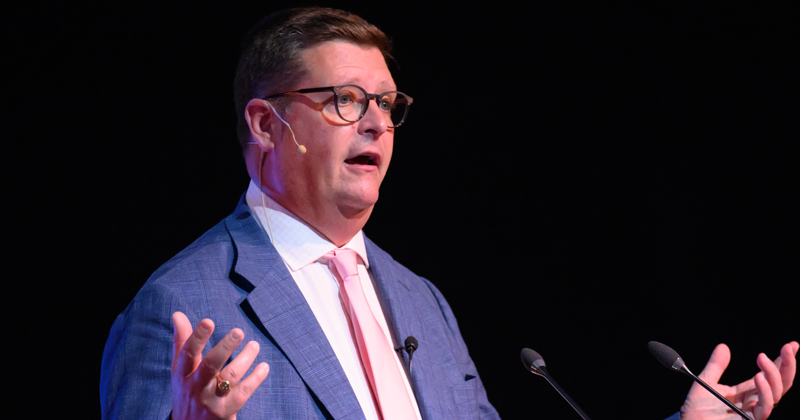
Ofsted boss Sir Martyn Oliver has admitted merging the behaviour and attendance judgment areas in the watchdog’s new inspections “did bother” him “tremendously”.
At BETT UK in London today, an audience member asked Oliver about the joint “attendance behaviour” judgment, warning it was particularly difficult for schools in “highly deprived” areas where attendance might be lower.
Responding, Oliver stressed his “original intent” was to have behaviour and attendance as separate areas.
Ofsted’s initial plans proposed distinct judgment areas for “attendance” and “behaviour and attitudes”.
But Oliver said that during Ofsted’s consultation over its planned reforms “many people, many organisations” said “very clearly there were too many areas [and they’d] want to see a number of them combined”.
“And the areas that they talked about combining were curriculum and teaching, and attendance and behaviour.”
Ofsted’s consultation summary notes criticisms around “the increased number of evaluation areas”, but does not specifically cite any calls for those areas to be combined.
Around 4,900 education professionals responded to Ofsted’s consultation, making up 75 per cent of the 6,500 respondents. Yet the watchdog has come under fire for only giving a broad, narrative summary of their responses, and not providing details of how many supported or opposed its plans.
‘I did tell you so’
Under the final framework judgments were condensed, reducing the overall minimum number of judgment areas for schools from eight to six.
“I have to say, it did bother me tremendously,” said Oliver.
“At the start…my expertise said they should be separate. But…consultations are real. It was overwhelmingly ‘combine’.”
Following the publication of the first new inspection ‘report cards’, leaders expressed concerns over the joint judgment area.
One leader, whose school was graded ‘needs attention’ after being marked down for attendance despite inspectors praising the behaviour of pupils, said it was “regrettable” the new system works this way.
Oliver said the category was “something that I am watching”.
“We’ll carry on watching it,” he said. “But there was a moment where I said, ‘I did tell you so'”. He added the system had “got what you wished.”
The Ofsted chief added that narrative summaries also give inspectors space “to explain where we might see a difference between” attendance and behaviour and whether “one is a limiting factor”.
New QR codes to prevent schools ‘cherry picking’ grades
Oliver also used his BETT address to announce newly inspected schools will soon be given QR codes to help prevent them from “cherry picking” grades shared with parents.
“You might be that school that’s got five exceptional so you might not want to talk about the [grades] that weren’t,” said Oliver. “And I want parents to see the whole report, not just the cherry picked part of it.”
Oliver said the QR codes, which will be introduced in coming weeks, can be published in letters schools send to parents about their Ofsted results, giving them fast access the full report.
But he added schools will not be required to publish the QR code.
Teacher Tapp’s Laura McInerney, Oliver’s interviewer this afternoon, asked whether the abolition of headline grades would mean schools simply describing themselves as “five exceptional” or “four exceptional” instead of ‘outstanding’ or ‘good’.
Oliver responded: “I think people will talk about it in that way.”
He said feedback from parents via the consultation showed “they wanted an overall picture that was easy to understand”, while the education sector “said they want narrative…the detail”.
Inspection stress won’t ‘magic away’
He said report cards give a combination of this.
Asked if he feels this “works for the sector”, Oliver responded that parents are “the primary audience of the report card”, and that Ofsted “exists to report back to parents”.
Meanwhile the verbal feedback schools receive from inspectors following an inspection is “very much designed for the sector”, said Oliver. “And that’s a much richer conversation than you could possibly capture in just the report card alone.”
Asked whether he feels the report card system will reduce the stress inspections place on leaders, Oliver said: “I hope so, but I’m not naive enough to say that it’s suddenly going to magic away.”
He described being a school leader as a “difficult” but “very responsible” job.












Your thoughts