

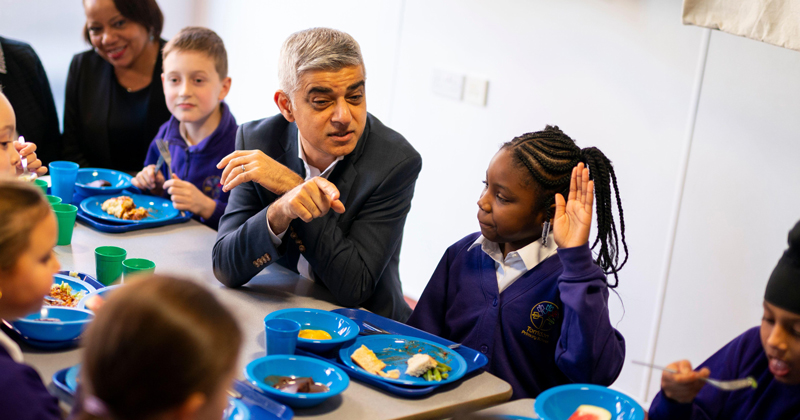
The Mayor of London’s universal primary free school meals scheme did not improve pupil attainment in its first year, but made a positive difference to family finances and stress levels, an impact report has found.
The interim report from the Education Endowment Foundation on Sadiq Khan’s offer of free school meals (FSM) to all primary school aged children in London looked at the first 10 months of the scheme.
The policy was first introduced in February 2023 to support families through the cost of living crisis. It now uses up around a third of the mayor’s total annual budget each year.
Researchers surveyed headteachers and parents, conducted interviews with parents and observed school lunch times in 14 locations across London.
It found there was around 90 per cent uptake among newly eligible children.
The policy was widely perceived positively by families, particularly those who fall just above the current threshold for means-tested support, the report found.
Of 1,475 parents surveyed, 80 per cent said it had made a difference to family finances, and 64 per cent said family life is now less stressful.
No impact on attainment
Researchers compared scores achieved by pupils who had gained access to FSM in London to similar pupils for whom access did not change.
This comparison found no measurable additional progress was made on average.
The report said this could be because at the time of research, the policy had only been in place for one academic year, whereas SATs at key stage 2 “assess cumulative learning across the entire primary phase, making short-term effects potentially difficult to detect”.
There were also no significant changes to attendance rates for pupils aged 10 to 11 years old who gained access to FSM compared with pupils with similar characteristics outside of London.
Other benefits for children
But many other benefits were reported for children.
One was that pupils were influenced by what their peers are eating, which encouraged them to eat different foods.
Teachers also suggested the policy had led to more children eating together and socialising at lunchtime.
Of the parents surveyed, 67 per cent said their child’s dietary needs had been met, and 82 per cent said lunchtime supported their child’s SEND needs.
Headteachers also anecdotally reported a reduction in poverty-related stigma at lunch time.
‘Additional burden’ for schools
The Greater London Authority provided around £2.65 per meal in 2023/24, which is higher than the national means-tested allowance.
Despite this, 44 per cent of schools indicated that the cost of delivering school meals exceeded the amount of funding given.
Researchers found “some schools struggled to recruit and retain catering staff, and others lacked space or equipment to scale-up provision”. But most schools adapted effectively to the policy, they added.
A spokesperson for the Mayor of London said: “These healthy meals are ensuring children don’t go hungry at school, fostering more inclusive and supportive learning environments and saving their families hundred of pounds a year”.
The Greater London Assembly could save around one third of its budget on the free school meals programme once eligibility for meals funded by central government is expanded to all families claiming universal credit in September 2026.
A final impact report from the London scheme will be published in 2026.









Your thoughts