

Bridget Phillipson will give herself the power to refuse new private special schools, after vowing to “clamp down” on private-equity backed firms “sucking money out of our education system”.
Ministers sought to contain expensive independent special school fees in their SEND reforms, proposing tighter regulation and increase financial transparency.
Council spending on these placements has risen to more than £2 billion a year. The growth accounts for almost a quarter of the total rise in high-needs spending since 2018, according to the Institute for Fiscal Studies.
In the white paper, the DfE said it was concerned “placements in the sector are contributing to unsustainable financial pressure” on councils “without clear evidence they are leading to better quality support, outcomes and value for money”.
Schools Week has revealed the soaring spend by councils on independent special schools amid the state capacity crisis in recent years.
Our award-winning investigation unveiled the big companies involved making millions, including those backed by private-equity investors and a Middle East sovereign wealth fund.
The government is proposing new statutory standards for private special schools, which would require them to offer placements based on new specialist provision packages and bandings. They will have to report their costs to councils.
The education secretary would have the power to refuse the expansion or opening of new private special school where there is limited evidence of demand from councils.
‘Negligent policy’
These settings “fill gaps where local capacity does not exist,” said Claire Dorer, chief executive of the National Association of Special Schools, which represents state and private schools.
“The independent sector is currently the only part of the system able to create new specialist places quickly and without upfront capital risk to the public purse.
“A policy designed to shrink provision before providing real alternatives is not strategic, it is negligent.”
Pepe Di’Iasio, general secretary of the Association of School and College Leaders, said price bands seemed “sensible and logical”.
But he said the government “must ensure that prices are set at a level which is sufficient to meet the needs of children who require significant support”.
Profit ‘should be focus on pupil outcomes’
Phillipson told parliament this week she would act “to clamp down on the massive expansion in private equity-backed, independent specialist provision that is sucking money out of our education system into profit when it should be focused on outcomes for children”.
DfE analysis found of the 15 private equity funds that own independent special schools, five are based outside of the United Kingdom. This includes Jersey, Guernsey, USA, Qatar and Abu Dhabi.
Collectively, these own 170 schools with 9,000 pupils, the DfE said.
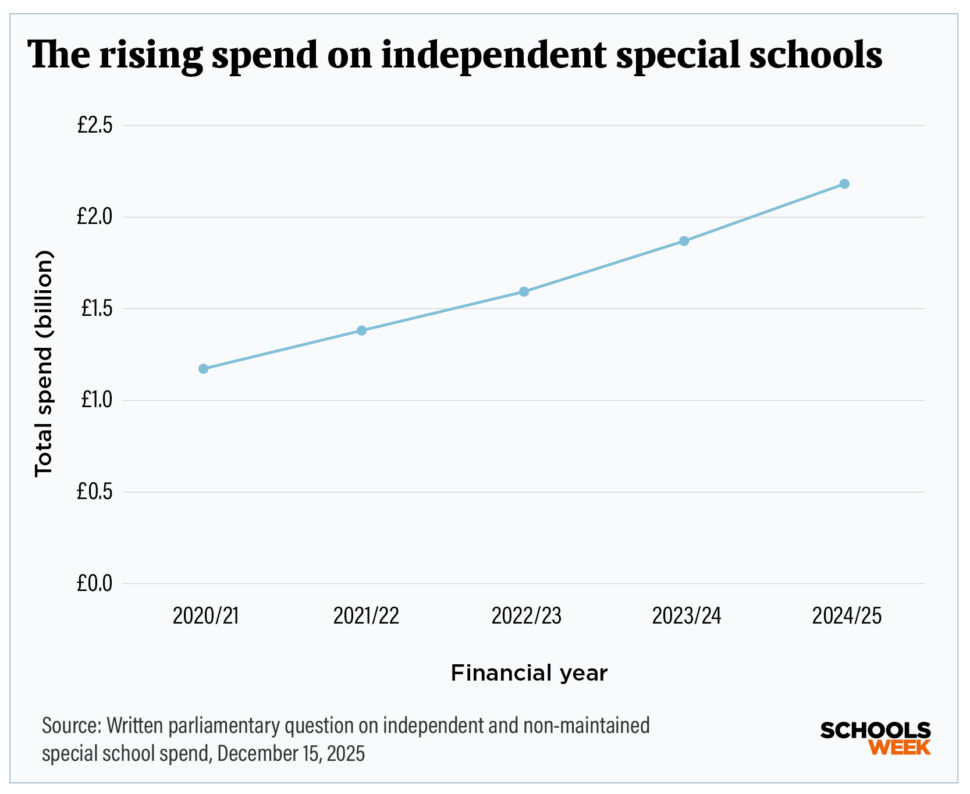
The schools charge an average of £63,000 per child a year – more than twice the £26,000 cost of a state special school, according to government analysis. Fees vary but some charge more than £100,000 a year.
The DfE expects the average fees councils can “pay will be lower in cash terms from 2028-29”.
Outcomes First Group, one of the largest providers, welcomed the proposals and said it had been “calling for these measures for some time, including outcomes-focused commissioning and stronger progress tracking for pupils with SEND that aligns closely with our own framework”.
However, it is “critical to have clarity and further detail quickly to ensure any new policy is implemented effectively”.
Government tsar advises private SEND firm
The government’s SEND adviser Christine Lenehan advises one of the largest private-equity backed independent special school providers, Schools Week can reveal.
Lenehan took up the chair role of Outcome First Group’s safeguarding and quality committee after retiring from the Council for Disabled Children.
She told Schools Week she agreed to take on a specific role which ensures “children in their services were safe”. But she also was a key adviser to the Department for Education on their SEND reforms.
Asked how conflicts of interested were managed, she said: “I am always aware of conflicts of interests in all the roles I take and am transparent with all parties.
“I am known for my credibility and professionalism, and would do nothing to undermine this.”
She added: “My views on independent special schools and their need to deliver high-quality education with a transparent funding base, and in partnership with local authorities is well known.”
André Imich, the DfE’s former SEND adviser, also sits as an independent member on the panel. He took up the role six months after leaving the DfE in 2024. He said the position was cleared by the DfE.
DfE took conflicts ‘very seriously’
The DfE said it considers any potential conflicts of interest in “great detail” and take them “very seriously”. It takes “all necessary precautions”.
Outcomes First Group made an operating profit of £7.1 million on turnover of £264.3 million in 2023-24. It was acquired by USA-based private equity firm TPG in 2023.
Its profits have been reinvested to strengthen provision, and all UK taxes are paid, a spokesperson said.
They added it ensures no conflicts of interest and that “our working arrangements are transparent and appropriate”.
It is “proud to have sector-leading experts on our safeguarding and quality committee. They help ensure the highest standards for the children and young people in our schools.
“The chair is an independent advisor supported by other independent education specialists. Together they help hold the organisation to account.
“The committee has operated effectively for more than eight years, playing a significant role in driving exceptional standards for children with SEND, reflected in the group’s consistently high Ofsted outcomes.”








Your thoughts