

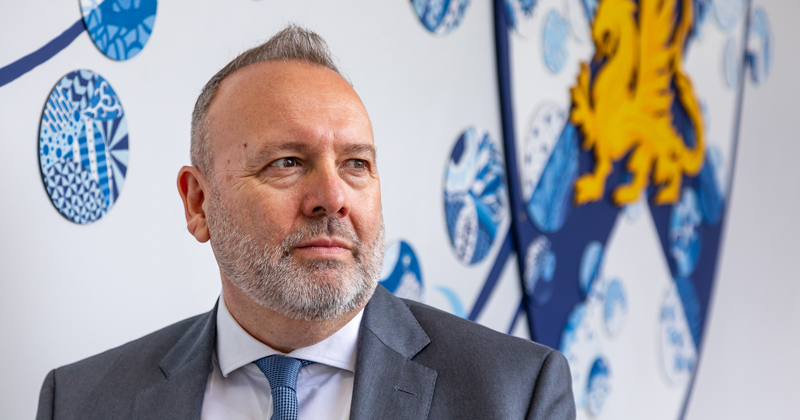
Uncertainty about the affordability of future pay rises will cast “a cloud” as school leaders gather for the ASCL annual conference, its general secretary Pepe Di’Iasio has said.
The Department for Education (DfE) last week predicted that schools will have around £1 billion of “headroom” over the next two years, meaning they could afford staff pay rises of 2.7 per cent over two years.
It said schools must “realise and sustain better value” in budgets to create further headroom and make a 6.5 per cent rise over three years manageable.
But speaking to Schools Week ahead of the annual two-day conference, Di’Iasio described the idea of headroom as “nonsensical”.
“There will be some schools who have more than the 2.7 per cent headroom, and the vast majority who haven’t,” the former school leader said.
Dozens of ASCL members have told him they “can’t manage” such a rise, he added.
“That will be something that is worrying school leaders right now,” as they await the report of the school teachers’ review body.
“I think that will be what is at the front of everyone’s minds. It’ll be a cloud over the conference.”
The pay decision will also impact schools’ capacity to deliver the government’s white paper reforms, Di’Iasio added.
The National Education Union is carrying out an indicative ballot to gauge if members would be prepared to strike over the proposal for an unfunded 6.5 per cent rise.
ASCL is not yet considering a similar ballot. “I would prefer to consider [that] once we know what the parameters are,” Di’Iasio said.
“At the moment it’s a cloud, but we don’t know whether it’s going to be a raincloud, or if some sunshine might break through.”
On the white paper
Di’Iasio feels the white paper has “landed really well”, and members broadly view the planned reforms as “sensible”. But they now need clarity on implementation.
“Our members are saying, ‘so how are we going to realise that plan? What does it mean for me?’”
ASCL is working with the DfE and members to clarify timeframes, and how to prioritise reforms.
Di’Iasio said most pushback had come around ministers’ expectations for all schools to join or form trusts. But members have a spectrum of views.
Some trust leaders feel it does not go far enough, while some running standalone academies or council maintained schools feel it is the wrong move.
“That probably means that they have got it just about right,” Di’Iasio said of the proposed reforms.
DfE experts involved in writing the white paper will hold surgeries at the conference to answer leaders’ questions. Di’Iasio welcomed the approach, saying the past six months have shown the department’s “real determination … to listen.”
Education secretary Bridget Phillipson will make a keynote speech this morning and Di’Iasio will interview her, “reflecting on the last 18 months and looking forward to the next 18.”
Ofsted concerns
Ofsted chief inspector Sir Martyn Oliver will also address leaders.
Di’Iasio said members were generally “pleased” with how new Ofsted inspections have been carried out since they were launched in December – broadly finding them more collaborative, while bringing more pressure.
But leaders say the timeframe of inspections is “incredibly challenging”, Di’Iasio said. “It puts incredible pressure on school leaders, particularly on SENCos and those leading inclusion.”
He also highlighted “fears around [inspections] being too data-driven and too predetermined on some key points of data.”
Schools Week has reported on concerns around how schools are compared against national averages for both ‘achievement’ and ‘attendance and behaviour’ under the new framework.
Leaders have also raised serious concerns about the merging of “attendance and behaviour” into one judgment area. Oliver recently said the decision “bothered” him and he was “watching” the issue.
‘Be kind to one another’
As Di’Iasio takes to the stage to open the ASCL’s conference at the ACC in Liverpool this morning, he will walk on to Olivia’s Dean’s hit ‘Nice to Each Other’.
His key message will be on “the idea of kindness”, and will be directed to everyone, including parents, the workforce, politicians and sister trade unions.
It comes as an ASCL survey, released today reveals the negative impact of parent behaviour on school leader wellbeing.
Of more than 1,700 members surveyed, 90 per cent had experienced rude or disrespectful behaviour, and 60 per cent verbal abuse or threats, while 57 per cent had experienced hostile or defamatory comments on social media.
“The theme of the white paper is about everyone coming together to do their very best for all young people,” Di’Iasio said. “I want us to remember in doing that that we need to be kind to one another.
“We may not be able to do everything that we want to do – or that perhaps one sector wants us to do – straight away. But at the heart of what we’re trying to do is a professionalism and a genuine sense of kinship.”











Your thoughts