


A recommended 6.5 per cent teacher pay rise over three years would see pay would grow more slowly than wider earnings which would hamper competitiveness, a new report warned.
The school teacher labour market in England annual report, published today by the National Foundation for Educational Research (NFER), paints a “happier” picture of the workforce than recent reports, with teacher recruitment and retention improving.
But it warned government “this is not the time for complacency”, as the progress “could easily be reversed”.
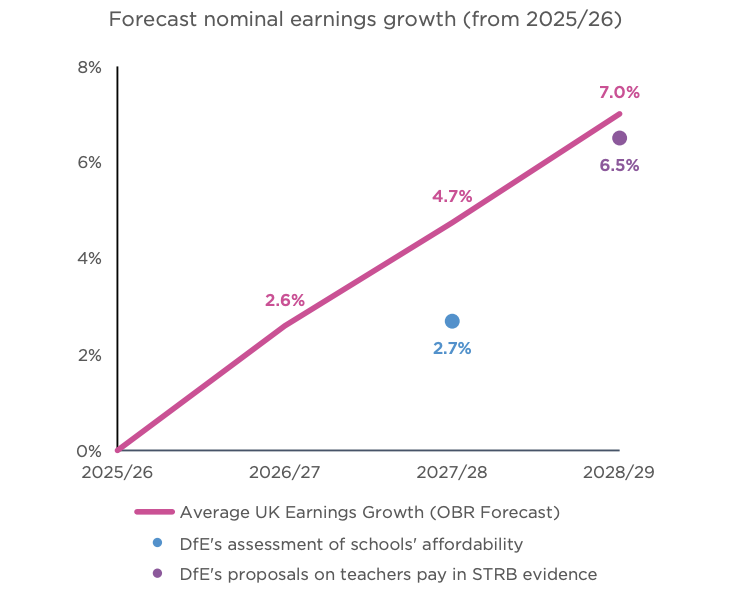
With general pay expected to rise by 7 per cent in the next three years, NFER says teacher pay should also rise by 7 per cent or more to keep pace and “continue to make the profession attractive”.
Here, we’ve wrapped up the nine key things you need to know, from NFER’s report…
1. 6.5% rise could mean falling pay
Recent above-inflation pay rises have placed teacher starting salaries on par in real terms with where they were in 2010-11.
But experienced teachers’ salaries “have only partially recovered” from a real-terms decline, and are still around nine per cent lower than they were in 2010-11.
The DfE has proposed teacher pay should be increased by 6.5 per cent over the next three years.
But NFER points out the OBR forecasts average UK earnings will grow by 7 per cent in that time, which “would result in a mild loss of competitiveness” which “could undermine the positive recruitment and retention picture”.
Paul Whiteman, general secretary of leaders’ union ASCL, said this “should serve as a stark reminder to government that the teacher pay problem is far from solved”.
He said “very early signs of improvement” around recruitment and retention “should not be misread”. “Only by restoring pay, modernising conditions, rebalancing workload, and reducing the stress of the job, will we solve this crisis.”
2. Overall recruitment appears ‘much improved’…
Overall recruitment to initial teacher training (ITT) increased in 2025-25. This is “likely driven by deteriorating employment opportunities in the wider labour market”, said NFER.
Primary recruitment hit its target for the first time in four years, recruiting 9,800 against a 7,700 target. Overall ITT performance was also the best it has been in four years.
NFER said an increase in bursaries “may have helped some subjects”, but it appears “largely down to” a slower wider labour market, particularly for graduate and entry-level jobs.
3. …but secondary recruitment remains below target
However, overall recruitment remained below target for secondary, where around half of subjects under-recruited.
Business studies – including economics – was the worst-performing, at around 70 per cent below target with just 270 recruits against a target of almost 900.
The secondary ITT recruitment target has been missed every year since 2015-16, except in 2020-21.
The last two years have shown “signs of progress” with recruitment reaching 89 per cent, up from 61 per cent the previous year. But this was due in part to the target being lowered from around 24,000 to around 19,000.
4. …and special schools will need 2.3k more staff
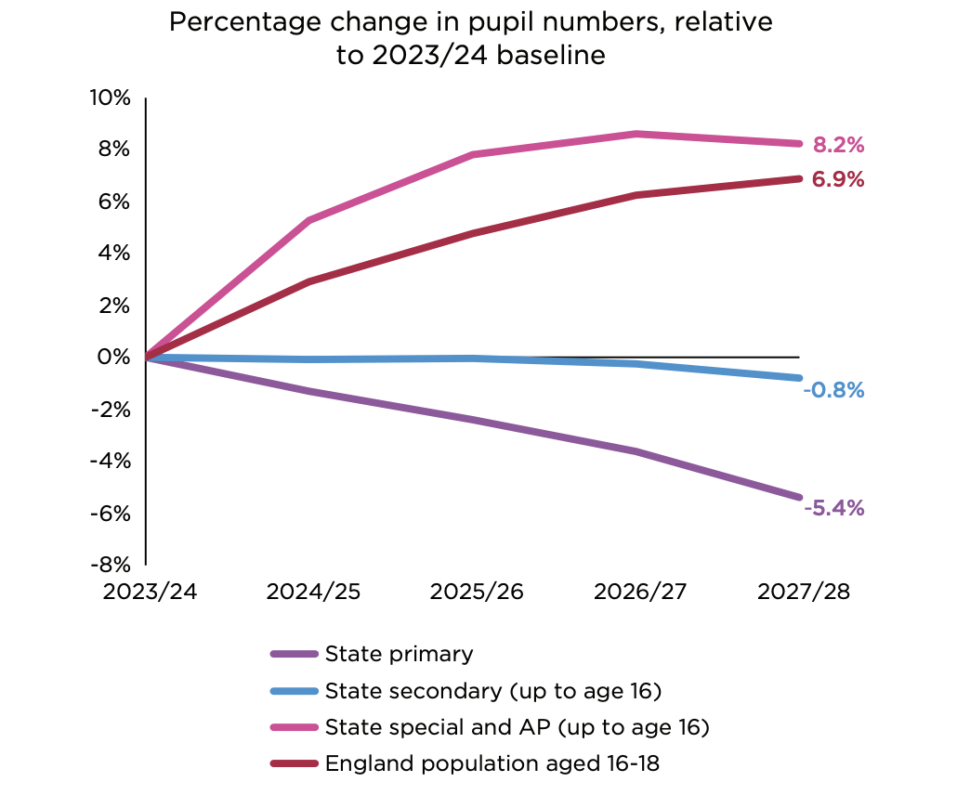
The NFER also predicted thousands more teachers will be needed in state special schools and AP settings by 2027-28.
Pupils in these settings are forecast to grow by 8.2 per cent, which will likely mean “additional demand for teachers”. An equivalent rise for FTE teachers in special and AP settings would mean 2,300 more teachers.
“However, the health of teacher supply into special schools and AP is not currently measured directly by DfE in the same way it is for primary and secondary teachers,” warned NFER.
5. Science recruitment appears to improve…
Physics recruitment is at its best level since 2016-17, hitting 78 per cent of its target in 2025-26.
The NFER said this was driven by an increase in international recruits, incentivised to apply due to bursaries being opened to non-UK nationals for the first time since 2022.
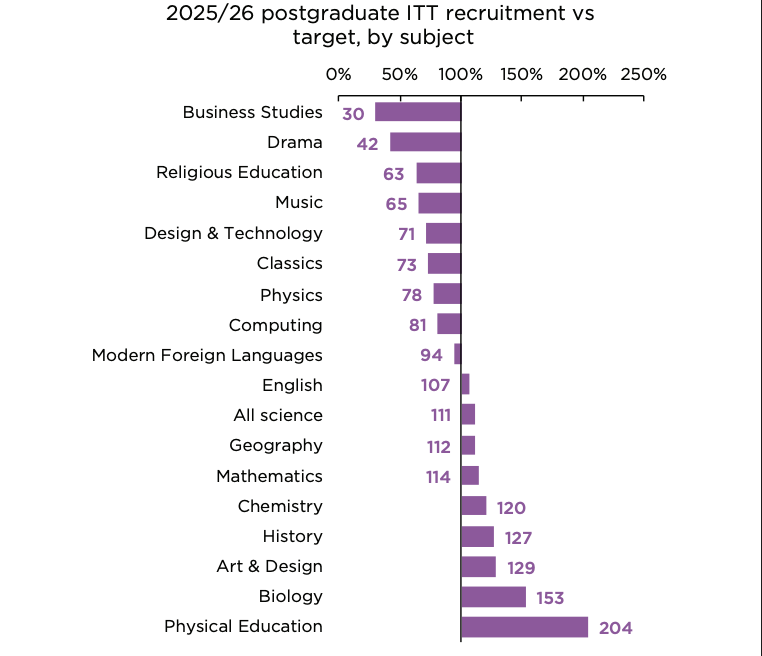
Chemistry recruitment was above target for the first time since 2014-15, and science was above the combined target for the first time since 2012-23.
6. …but bursary cuts are being felt
The NFER said overall recruitment “may well have been ahead” had bursaries not been cut.
Some subjects like English and geography are recruiting less than they might otherwise due to the cuts, the think tank warned.
Subjects where bursaries have been cut by £10,000 or more have seen a 36 per cent fall in accepted applicants, compared to the same point last year. Subjects that have not seen cuts are seven per cent higher, on average.
NFER said reducing bursaries “is counterproductive, particularly given the government’s target to recruit 6,500 more teachers”.
7. Retention improves modestly
Teacher retention has improved since a post-pandemic spike.
Between nine and 11 per cent of teachers have left the state system every year since 2010, except during the pandemic. Nine per cent left the system between 2023-24 and 2024-25, equating to more than 8,000 teachers.
The exit rate for first year teachers was 10.3 per cent – the lowest on record. The NFER said this suggested the new early career framework (ECF) may be having a positive effect, though whether these cohorts have permanently lower exit rates “remains to be seen”.
8. Teachers feeling more positive…
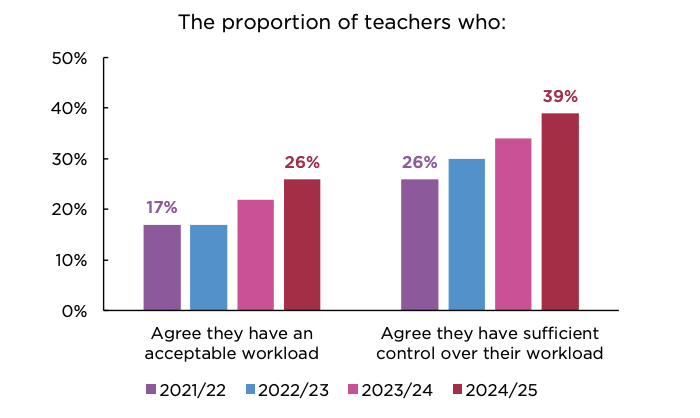
Teachers are more positive about their workload that four years ago. And working hours have fallen slightly, according to two different surveys.
But the NFER said “there is further to go”. Teachers are 11 percentage points more likely to say they want to work fewer hours than similar graduates.
9. …but reforms could mean higher workload
Two major policy developments could mean increased workload “if not implemented carefully”.
First is the new national curriculum, and the second is the government’s SEND reform programme, which “could also increase the workload burden many teachers face” as schools will be expected to create individual support plans for pupils and review them regularly.
10. …and CAR may require more teachers
The education secretary previously acknowledged more specialist teachers will be needed so schools can deliver a new entitlement to offer triple science to all pupils – a key ambition of the curriculum and assessment (CAR) review.
The NFER report echoes this, adding the change to how attainment 8 is measured could lead to an increase in pupils entering arts subjects and languages, while teacher supply may “not support rapid expansion”.
11. Recommendations
The report made three recommendations.
First, it said the STRB and government “should aim to maintain the competitiveness of teachers’ pay” by matching the growth in average earnings outside teaching, and funding schools to deliver this.
It also warned the government “should consider bursary increases for languages and arts subjects that are below their ITT targets”, to support the implementation of the revised
curriculum.
It said the DfE should also “conduct more deliberate workforce planning” for special schools and AP, as it does for primary and secondary teachers.

NFER workforce lead Jack Worth said: “Following more than a decade of persistent teacher recruitment and retention challenges, it is encouraging to see some signs of improvement.
“However, this is not a time for government or the sector to rest on their laurels.
“Overall secondary recruitment remains below target. If the government wants to achieve its 6,500 teacher recruitment pledge and maintain healthy supply into the future, it must continue to make the profession attractive. This includes increases to teachers’ pay that match or exceed wider earnings growth and further progress on reducing teacher workloads.”













Your thoughts