

More pupils with special educational needs will be educated in mainstream schools under government inclusion plans, with money due to be “rebalanced” from high needs to core school budgets.
Schools Week investigates how the current system punishes inclusive schools financially, with leaders facing making cutbacks to maintain current levels of support.
“Year on year it has been increasingly challenging to set a balanced budget,” says headteacher David Rogers. “We have had no choice but to reduce costs across the whole school.
“We have finally reached the stage where there is nothing left to cut and are now in a budget deficit.”
At his school, Bentfield Primary in Essex, four in 10 pupils were either on the SEN register or had an education, health and care plan in 2023-24.
The school has 24 enhanced provision places for children with learning difficulties, who are taught alongside mainstream peers but with adapted curriculums.
“Being inclusive is at the heart of everything we do,” says Rogers, but adds the “enormous benefits for every single one of our pupils” stem from a “staff intensive” approach.
“Many of our enhanced provision pupils need full-time intimate care across the whole school day, including playtimes and lunchtimes, as well as support with feeding and when addressing medical needs.
“There are often occasions – for example, when hoisting and changing pupils – where two members of staff are required.”
Huge spends on support staff
Schools Week analysed school-level Department for Education demographic and financial data for 2023-24. The dataset included mainstream state primary and secondary schools, both academies and maintained.
Mainstream primaries where less than five per cent of pupils had designated SEND spent on average of £1,104.05 per pupil on education support staff and £80.67 per pupil on education consultancy.
By contrast, schools where more than 40 per cent of the school roll had designated SEND spent £2,238.29 per pupil on education support staff and £319.11 per pupil on education consultancy.
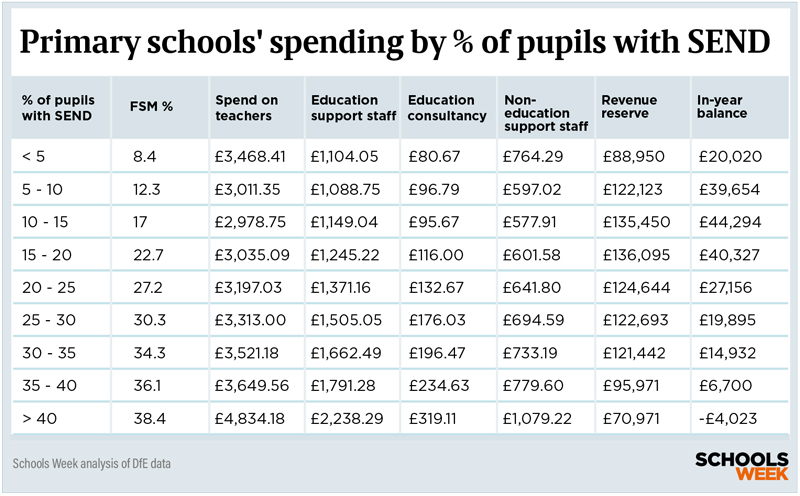
Schools receive extra funding to support children with EHCPs. But even when looking at the proportion of their total income, primary schools with the highest proportion of pupils with EHCPs spent 21.5 per cent of their income on support staff, compared to 15 per cent of those with the lowest.
“We know that it does cost money to support children with additional needs and we know that the funding that schools currently get doesn’t always cover that as well as we would need it to,” says Charlotte O’Regan from social mobility charity the Sutton Trust.
“If you’ve got children that are disadvantaged and with SEND, and then they’ve got parents who, despite the deepest desire to do so, [don’t have] the resources to financially support them, you then have to back that up. The school then have to spend that money.”
Poor finances
Our analysis found primary schools with more than 40 per cent of pupils with SEND had markedly worse finances than those with smaller SEND intakes, recording an average in-year revenue loss in 2023-24 of about £4,000. The median primary school made a surplus of about £40,000.
Bentfield spent £3,951 per pupil on education support staff in 2023-24 – high even by the most SEND-inclusive schools’ standards– and spent relatively highly on non-education support staff. However, the school registered a £54,000 in-year revenue loss that year, followed by an £89,000 loss in 2024-25, leaving it with just £20,232 in revenue reserve last March.
Despite rising SEND numbers, the school has cut learning support assistant work by 85 hours a week in the past year, mainly to cover pay rises and higher national insurance contributions, which Rogers said were “nowhere near fully funded” by the government.
Lunchtime assistants have been cut by a quarter since 2023-24. Spending on learning resources has fallen substantially, with the parent teacher association and outside fundraising playing increasing roles.
Senior leaders have taken on more teaching responsibilities; the supply teacher budget has been cut to zero, meaning absences must be covered internally. Spending on costs associated with school grounds and buildings has been reduced.
“SEND funding remains stagnant and has done so for far too long,” said Rogers. He welcomed the government’s reported plans to increase high-needs SEND provision in mainstream schools, but said it was “imperative” this was funded properly with annual uplifts and support staff pay rises.
“Without this, it is deemed to fail and will further reinforce the reluctance that many schools have to be fully inclusive, despite the amazing benefits it can offer,” he added.
‘Our inclusion team is bigger than our English department’
In mainstream state secondary schools, some primary school patterns are repeated. Rising SEND cohorts are accompanied by higher spending on education support staff, per pupil and as a share of total income. Per-pupil spending on teaching staff is flatter; there is no clear trend in schools’ financial fortunes.
At Rugby Free Secondary School in Warwickshire, 27 per cent of students in 2024-25 either had an EHCP or were on the SEN register.

Headteacher Iain Green said its SEND inclusion team is “by far” the school’s biggest department. “It’s bigger than our English department, it’s bigger than our maths department, it’s bigger than my senior leadership team.”
In recent years Green has recruited two SENCOs, two assistant SENCOs, a SEND administrator, an EHCP co-ordinator, two mental health support workers and other support staff.
The school has a specialist resource provision, which with the school’s pro-inclusion ethos, attracts parents of SEND children.
“We’ve had to employ additional staff to deal with the number of SEND students that we have due to our popularity, which is a nice thing as it shows how inclusive and supportive we are, but also it’s difficult when you have the local disparities in SEND intakes that we might see,” Green said.
He pointed to the time spent on training. “That all has a cost. It might not be a financial cost, but it has a time cost, and absolutely worthwhile by the way, but you can’t put a measurable, tangible figure on that.”
‘Challenges’
Having high proportions of pupils with SEND is “creating challenges for schools, challenges in terms of pressure on school staffing, definitely on funding and on access to specialist support,” said Matt Walker, senior researcher at the National Foundation for Education Research.
Walker added that mainstream schools with the largest SEND cohorts were generally those with on-site SEN units or resource provision. These represent the DfE’s preferred direction of travel according to recent announcements.
Schools Week’s analysis found big local disparities in mainstream schools’ SEND intakes. In 2024-25, 94 mainstream state secondary schools had SEND cohorts under five per cent of the school roll – sometimes as low as one or two per cent.
In five full-size secondary schools, there wasn’t a single child with an EHCP. Nationally, 14.2 per cent of pupils receive SEN support, while 5.3 per cent have an EHCP.
However, there are limitations to identifying inclusive schools based on the size of their cohorts alone, given schools can categorise pupils in different ways.
The 94 schools’ SEND cohorts, measured as a percentage of their total student bodies, were anywhere between one half and one 20th of the average among neighbouring schools. Eighty of the 94 schools are selective.
“Selective schools, by their nature, are typically not representative of the communities that they serve,” said Jon Andrews of the Education Policy Institute, pointing to wide attainment gaps at the end of primary school for pupils from low-income families and those with SEND.
“By selecting based on tests at age 11, these pupils are less likely to meet the criteria for admissions.”












Your thoughts