
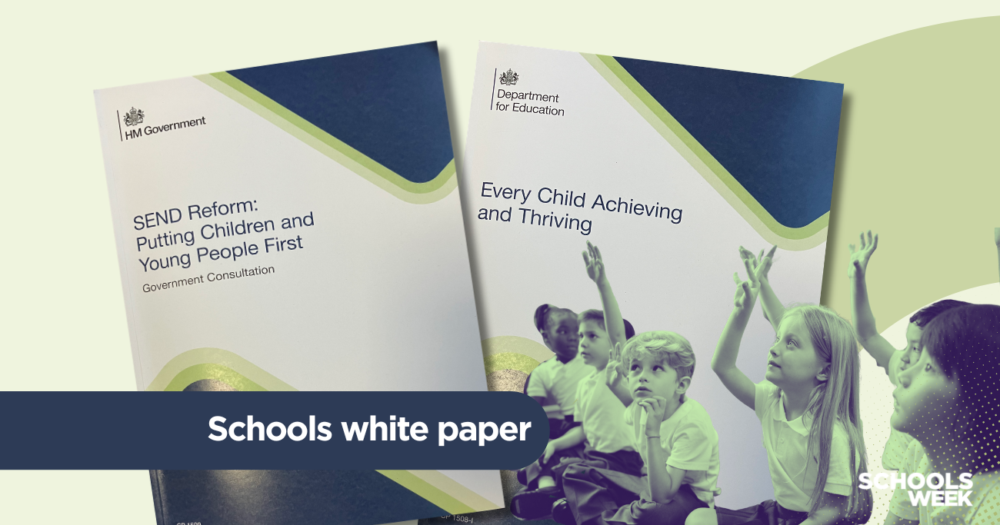
Pupils with only the “most complex needs” will require education, health and care plans (EHCPs) by 2035, the government has said as it outlines its large-scale reforms to the SEND system.
The schools white paper has proposed a new layered approach to SEND support where schools will be tasked with creating individual support plans (ISPs) for pupils with less complex needs, which will be legally binding.
The government will also look to review existing EHCPs after September 2029, which it expects will transition one in eight pupils from EHCPs to an ISP between 2030 and 2035.
EHCPs would also be produced after a package of support is already put in place for a pupil, reversing the current system.
Here’s everything you need to know about the proposed changes.
1. Specialist support
Reforms propose that children with SEND will fit into two levels of support: targeted and specialist. While targeted support will apply to pupils in mainstream schools, specialist support will apply to children with more complex needs in both mainstream and special schools.
Those receiving specialist support will be entitled to an EHCP. But there are plans to change how these are issued.
Government is proposing that a child’s provision is secured before an EHCP is issued. This provision will be based on a “statutory entitlement” outlined in what they are calling a “specialist provision package”.
These packages include profound and learning difficulties, significant executive function, complex executive function and communication, social and emotional development focused on externalising behaviour and internalising behaviour, sensory impairment and psychical disability.
These packages will then inform what provision is needed for a pupil, which will be put in place with regular discussion between parents, schools and councils.
The council will then issue an EHCP, while the school will issue a more detailed IPS.
2. Existing EHCPs to be reviewed from 2029
EHCPs currently form the basis of the SEND system in England, and the government says it will not introduce these changes until 2029.
This means all children in year three and above today will retain their existing EHCP until at least age 16.
From September 2029, the government will introduce the requirement for children on EHCPs to be assessed at transition points throughout their school career. This will be between primary and secondary school.
“Many more needs will be met through the universal offer and targeted layer including through experts at hand, without an EHCP,” consultation documents say.
Councils will assess whether a pupil’s needs fit a specialist provision package, and in turn an EHCP. If they don’t, their school will develop an ISP instead. This means that those transitioning from an EHCP won’t lose statutory support.
3. Changes for councils
The proposed reforms also outline certain changes to parent and council rights in the EHCP process.
The law will be amended so councils are required to give a list of recommended settings that could deliver the specialist support package for the child.
Councils will also no longer be required to name a school in an EHCP that is already full.
Value for money and effectiveness of a resource will also be prioritised.
Consultation documents say placement decisions “will be made in a much more consistent and fair way, with preferences made less in isolation and more holistically, with a better focus on quality and a suitable placement close to home”.
The “presumption to mainstream”, which gives councils the legal duty to place children within mainstream settings if that is what parents want will remain.
4. Right to tribunal to remain
Families will retain their right to appeal aspects of an EHCP through tribunal.
But consultation documents say government will “improve complaints and mediation processes so disagreements are resolved faster and more collaboratively”.
Government figures recorded 21,000 registered SEN appeals in the 2023-24 academic year, of which 27 per cent were against councils’ “refusal to secure” an EHCP assessment, while 59 per cent were over the content of EHCPs.
5. EHCP rates expected to rise – before dropping
Government expects there will be a rise in the number of EHCPs issued between now and 2029. But it then expects figures to fall, roughly to existing levels by 2035, as more children’s needs are catered-for by mainstream schools.
While 5.3 per cent of England pupils currently have an EHCP, this is expected to reach 7.7 per cent by 2029-30, but then reduce to 4.7 per cent by 2034-35.
Around 1 in 8 pupils are expected to transition from an EHCP to an ISP between 2030 and 2035.
Projections also outline that two thirds of secondary schools will have an inclusion base by 2029-30.
And by 2030, an estimated 15 to 20 per cent of pupils will have an ISP.










Your thoughts