


Pupils’ special educational needs will be met through a new layered system of support, with education, health and care plans reserved for only the most complex cases.
Schools will be tasked with creating new individual support plans (ISPs) for pupils with less complex needs. They will be guided by new inclusion standards and a duty to create an inclusion strategy.
The schools white paper and a corresponding consultation have set out proposals to SEND reform, most of which are expected to be enacted from 2029. From that date, pupils with EHCPs will have them reviewed when they reach their next transition point in secondary.
Legislation underwriting some of the reforms will be brought in at the “earliest opportunity”.
It comes after the government announced plans to hand mainstream schools extra funding to provide early intervention, and another fund to improve availability of local experts like educational psychologists.
Here’s how the new tiered system will work…
1. The universal offer
The Department for Education’s new system will start with a universal offer for all children.
This will set a “new baseline” for mainstream schools. DfE expects most children to have their needs met under this tier and teachers will be trained to meet these expectations.
It will include inclusive leadership and governance planning, evidence-based support and strong partnerships with families and wider services.
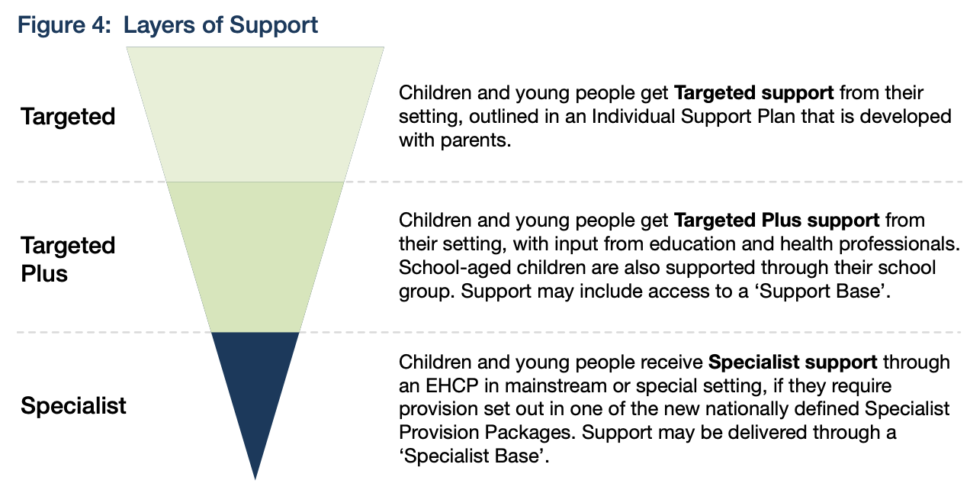
2. Three ‘layers of support’
The next three “interlocking” tiers are designed to be flexible layers which can be drawn on from day one, DfE said.
For example a child may start off being supported by the universal offer alone, but draw on the three layers of support as their needs change over time.
Targeted
This will be for pupils with “ongoing and commonly occurring needs” which cannot be met by the universal offer. It will be designed in consultation with parents.
It could include small group interventions, or “pre-teaching” key vocabulary to help access the curriculum.
Each pupil will have their needs and provision captured in an individual support plan (ISP). The plans will be drawn up by schools.
The DfE has said new ISPs will be “interactive, accessible and available in a digital format”.
Targeted plus
For pupils who need more specialist support, schools will be able to draw on the new “experts at hand” service which aims to improve access to education and health professionals.
These pupils will also receive an ISP and have access to a new “inclusion base” where needed. It may also involve time-limited support in an alternative provision or a specialist setting.
This would “allow pupils a short time placement for their needs to be assessed and addressed before reintegrating back into a mainstream setting”.
Specialist
This will see mainstream and specialist settings work in close partnership for the children with the most complex needs.
New “specialist provision packages” designed by experts and tested with parents will outline packages of provision based on evidence to support these pupils. Access to the new “specialist bases” will be available.
In future only children who need this support will be entitled to an EHCP. They will also have an ISP.
3. The future of EHCPs
EHCPs will be created after a specialist package and placement decisions have been made, rather than beforehand.
If a pupil is assessed as not requiring an EHCP, the council will be expected to work with the school to ensure appropriate support is in place. Plans will also be digitised.
From 2029-30, children with EHCPs will be assessed against the new threshold at the end of their phase of education.
All children in year three and above today will retain their existing EHCP until at least age 16. Children in year two or below today will be reassessed at transition between primary and secondary.
Those whose needs are best met with additional support in mainstream will transition to an ISP.
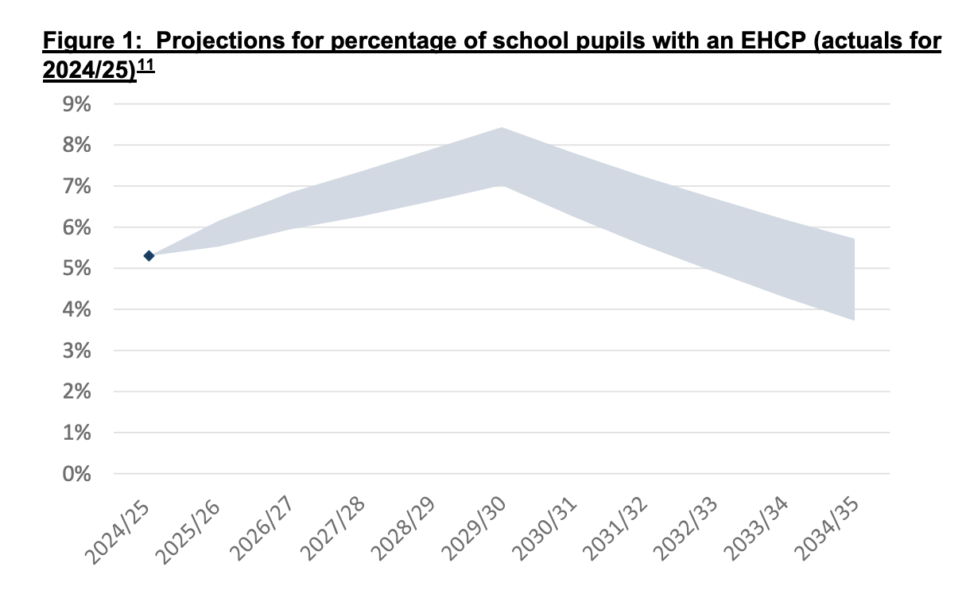
But DfE expects the number of children with EHCPs to continue rising over the next three years, returning to today’s level by 2035.
4. Special school curriculum review
All pupils who have a special school place in September 2029 will be able to stay in this school until the end of their education, unless they choose to move to a mainstream setting.
But DfE will work with experts to review “good curriculum practice” in special schools. These schools told officials they would welcome national best practice and guidelines.
Special schools and alternative provision will be expected to provide outreach and short-term placement for some children and young people enrolled in mainstream settings.
5. National inclusion standards
The new tiers will be guided by new standards to set “clear, evidence-based” guidance for the universal offer, as well as what targeted, targeted plus and specialist layers of support should look like.
By 2028, DfE will invest up to £15 million to build the evidence base for these standards.
An independent expert panel will oversee their development.
6. School ‘inclusion strategy’ duty
Schools will have to “proactively plan” the support they provide through a new duty to produce an annual inclusion strategy.
This will replace the existing duty to create SEN information reports.
Ofsted will assess how leaders ensure this new strategy is embedded in practice and how staff are equipped to deliver it.
The strategy will show how schools intend to use funding on inclusion.
7. Updated code of practice
The existing, statutory SEND code of practice will be updated and consulted on. DfE said these changes will be supported by stronger accountability.
There will be a new requirement for all settings to ensure staff receive training on SEND and inclusion and to clearly signpost government funded training.
In a refreshed code, DfE proposes new areas of development. These are: executive function, monitor and physical, sensory, speech, language and communication and social and emotional.
DfE will also set out what schools should do to support pupils with mental health needs, whether or not they have identified SEND.
8. New SEND clusters plan
The white paper proposed that “every school should be part of a local group to work together on SEND”.
These groups would need to be “actively engaged” with their local authority and integrated care board.
“We would like to work with school and local authority partners to learn together while we move in the long term to a system where all schools are part of strong group.”
And in the long term, schools will pool some funding from their inclusive mainstream funding for a “more collaborative, efficient system to meet needs across their group and allow for better sharing of expertise and resources”.
DfE will place conditions on inclusion funding to make sure it’s spent on improving the SEND offer.
9. High needs funding diverted to school budgets
According to the white paper, the government plans to “re-balance” funding, directing more high needs funding into core budgets for schools and colleges.
It will continue to use proxies which correlate with SEND in the national funding formula, rather than funding identified SEND need directly.
But government will also streamline the current school funding landscape, “clearly identifying each school’s share of their core funding for inclusion”.
10. A new performance measure
The government has also pledged to update performance measures to recognise schools that secure good progress for all young people.
Ministers had already pledged to reform progress 8 to encourage take up of a broader range of subjects.
The white paper pledged to consult on a new performance measure, in addition to progress 8, focused on the progress made by pupils who enter secondary school behind their peers.
11. Improved complaints scrutiny
The white paper has pledged to improve the complaints and mediation processes, so disagreements are “resolved faster and more collaboratively, reducing the need for an appeal to the SEND tribunal”.
DfE has also pledged to work with school and college leaders, parents and the sector to strengthen the mainstream school and college complaints process. This will include a new “digital solution” for handling complaints.
Ministers will also explore options for strengthening independent scrutiny over school complaints data.
12. Tribunal to continue as ‘last resort‘
For complaints about specialist provision, the government will seek to strengthen council-commissioned but independent mediation services.
They expect the “vast majority” of disagreements to be resolved through these routes, but if parents still have a complaint about a council’s decision not to carry out a needs assessment, they will continue to be able to appeal to the tribunal for a ruling.
The tribunal will also hear appeals against council decisions about whether a child meets the threshold for specialist provision.
13. New oversight remit for children’s commissioner
The DfE has announced there will be a new remit for the children’s commissioner for England to provide “oversight and scrutiny of SEND reform implementation”.
The commissioner will be asked to monitor the progress and effectiveness of the reforms, with a “particular focus” on children in care, children in need, those not in school
14. DfE power on private special school expansion
DfE already announced a crack down on independent special school profit.
But in the detail today, the education secretary will be given the power to refuse the expansion or opening of new ISS, where there is limited evidence of demand from commissioning LAs.
ISS will be required to offer placements based on the specialist packages and have to report costs to the commissioning council.
Any ISS that doesn’t meet the new national standards and duties will not be able to register as an ISS, provide specialist placements commissioned by councils and receive state funding.











Your thoughts