
When Andrew Truby answered a “mysterious” job advert and became the sole employee of a government-trialled Catholic turnaround trust, he was unsure what the future would hold.
But while another trust set up with the same purpose – taking on “schools no one wants”, or SNOWs – quickly closed, St Joseph Catholic Multi Academy Trust now has 10 academies and permanent status.
And Truby is using his platform to speak out about education policy, voicing concerns over Labour’s school improvement drive and calling for a MAT CEO pay scale after his own wages were highlighted by the government.
‘Wild’ stag dos
We meet in a café in Retford, Nottinghamshire. It’s a noisy place. Noughties music rings out, along with the scraping of plates and hissing of coffee machines.
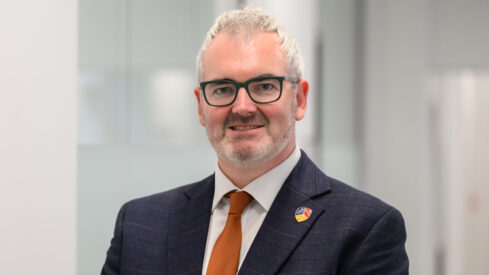
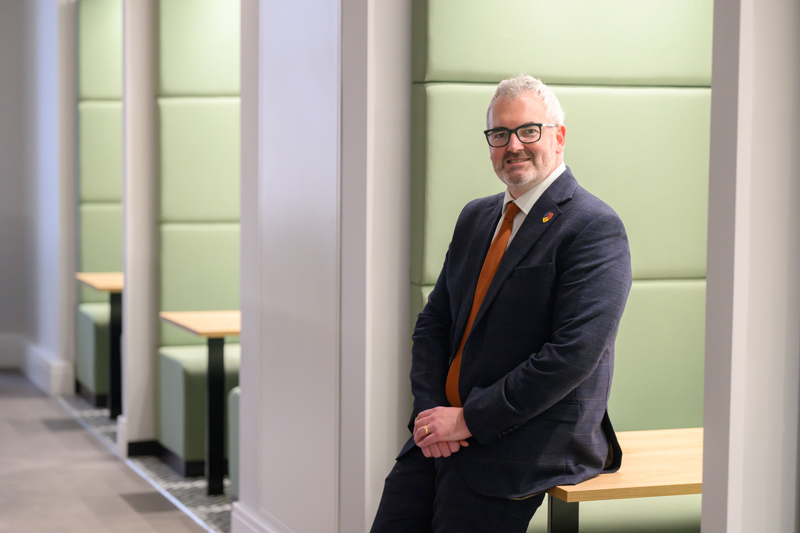
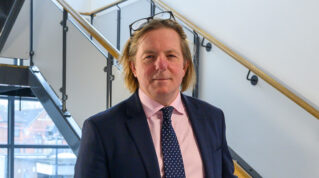
Truby’s dressed in a blue suit. A badge, decorated with his trust’s colours, is pinned to his jacket lapel. Softly spoken and with grey hair, he tells me he’s 45, but jokes: “I look older, I’ve been through a lot.”

He was brought up in the Northumberland village of Seaton Sluice. Sundays were spent at church. His parents taught French in secondary schools.
In his teens, Truby spent weekends working at his aunt’s hotel in Whitley Bay. It was “wild”, with stag and hen dos regularly descending.
“It was quite eye-opening,” he says. “I learned to deal with some really drunk people in difficult situations which could be dangerous, could get out of hand. You learn different skills in communication, de-escalation.”
Tutoring ‘solution’
While at university studying French and Spanish, Truby had his first taste of teaching. As tutors, he and a friend led language lessons in schools and colleges.
After completing his studies and securing a PGCE, he went solo, taking “the whole [business] on”. At its height, the firm employed 30 teachers across the north of England.
“I saw an opportunity. It was the time when [the Labour government] had just brought in 10 per cent PPA time for teachers and schools were struggling with a solution to that. My solution was …languages.”
Truby says he was freeing up teachers to have their breaks, while also giving schools someone to lead language lessons.
In 2006, Truby moved with his wife, who is now the deputy head of a Catholic school, to Sheffield. He “applied for lots of different jobs”, taking a role at St Marie’s Catholic Primary.
Leadership fast-track
Truby was on a fast-track leadership programme at the time and, three years later, was appointed deputy head at another school in the city – St Thomas of Canterbury primary.
Before starting the role, he learned the head was due to retire. The school began recruitment with Truby keeping the seat warm. But he saw an opportunity.
“I proposed to the chair of governors at the time and to the diocese, ‘You’ve only got one person in for [interviews] and if you wanted to interview me alongside, I’m offering myself to do that,’” Truby says.
“I knew they may have laughed me out of the door. When I think about it now, I think it’s a crazy thing to do.”
His gamble paid off and he was given the top job. Truby was 29, and believes he was one of the country’s youngest heads. He soon realised “there were lots of things I didn’t know. I was really idealistic”.
Outcomes fall
The sector was abuzz with “excitement… [carried over] from the Blair administration”, he recalls. There was “a lot of wacky stuff going on”.
“I was in a creative partnership and there was a lot of money for random projects, [like] you could bring artists into school [and] we had sculptors. It was called a creative curriculum move – completely the opposite of a knowledge-based curriculum.
“But as a result of it, our results went down in 2011. I had to do some really hard thinking.”
Truby remembers feeling he had “done all this stuff, got all these grants” but was still asking himself “what the heck is going on?”
He concluded the school “hadn’t sorted out the basics”. He and his staff “tightened everything up”, introducing behaviour expectations, “a clear lesson structure” and a “defined curriculum”.
In 2014, it secured an ‘outstanding’ Ofsted. This “led to other things”, Truby says, with the primary becoming a teaching school and he became a National Leader of Education (NLE).
The NLE programme saw leading headteachers – who had to meet specific eligibility criteria – support challenging schools. It has been replaced by Labour’s flagship RISE school improvement drive.
Good money after bad
For this, 65 experienced turnaround leaders have been seconded as advisers who are appointed to specific underperforming schools to identify priorities and propose an outside organisation to deliver support over two years.
During his time as an NLE, Truby “occasionally” worked with “really exceptional” leaders who “developed” over the course of the programme. However, the “reverse” was more common.
“You’ve gone in there, leadership has been an issue to begin with, they’ve gone along with your plan – but when you’re not going back, they’ve reverted to what they were doing before,” he says.
“Unless you’ve got someone really driving [improvement] … [these heads] will quickly fall back into getting absorbed by the things that were distracting them before.”
It’s for this reason he fears RISE “could waste a lot of time, energy and resource”, as well as “children’s one opportunity in the classroom”, if the leaders of the struggling schools aren’t up to snuff.
“My concern with the programme is, do you just keep throwing good money after bad? [RISE advisers] should be able to at least make the case for a structural intervention to ensure they can go to the right place.”
Mystery advert
In September 2021, Truby interviewed for a new job. He’d seen a “mysterious”, “intriguing” advert for a role leading a not-yet-launched Catholic turnaround trust as part of a Department for Education pilot.
The trial – which also funded the formation of the Falcon Education Academies Trust – was started to find a temporary home for “orphan” schools. The idea was they would be “incubated” by the trusts, before moving to a permanent home.
He became CEO of the new Liverpool-based trust, that became St Joseph Catholic Multi Academy Trust, in January 2022. On his first day, Truby was its only employee.
“I had a bank statement, but I had nobody to sort it out and get money from the DfE. We were building the plane as we were flying it.
“We had interim people, a lot of consultants. We literally couldn’t appoint people quickly enough into the roles with notice periods and everything else.”
Truby and the trust board agreed to have “a really decisive plan” for improvement as otherwise they were “going to fail”. School improvement directors were also hired from Harris Federation and REAch2.
He modelled the trust – which received £1.25 million in government start-up funding – on the likes of Ark, Outwood Grange and Dixons, organisations that “were high performing but also had high levels of disadvantage”.
“They’ve got a handle on curriculum, teacher development, behaviour systems. We wanted to ensure that we had the best possible fusion between what the highest-performing trusts do and how we have Christ at the centre.”
Pay crackdown
Data for that period was used by government officials to name and shame 37 trust CEOs, including Truby, for high pay.
To calculate this, the Education and Skills Funding Agency initially grouped trusts by type and pupil numbers “to minimise bias”.
CEOs were deemed to be “outliers” if they fell into the top 5 per cent in their band for having both the highest pay in absolute terms, but also as a proportion of their overall grant funding. No further action was taken against any of them.
But Truby says the workings that landed him on the list were “incorrect …because the period that was covered was a partial year [for St Joseph]. I was the only employee and we didn’t have schools, so it was completely skewed in that period.”
Schools Week later revealed how the clampdown allowed the biggest chains to escape scrutiny as the method used to identify “outliers” appeared to be loaded against smaller trusts.
Truby says his current £150,000 to £160,000 pay packet is “in the typical range”. But he believes the sector would benefit from a “trust leader national pay scale”, akin to those already in place for headteachers.
“We’re doing a role in education, in the public sector, and therefore we should have a range of pay, which would have a cap on it, [as] it would create more consistency. It could settle some of the debate.”
‘Relief’ and mega MATs
Just a year after St Joseph was launched, it was announced its sister chain Falcon would shut, having only taken on four academies since 2019.
But Truby’s MAT was given the green light to branch out and take on ‘good’ and ‘outstanding’ schools – easing its transition out of the government scheme.
The news was a “relief for the schools because [they] didn’t want to leave” St Joseph. All of the academies that have been visited by Ofsted since joining the trust have received improved grades.
“In our case there was a need for a Catholic trust where we were. [There were Catholic] schools with directive academy orders and no trusts to sponsor them,” Truby explains.
“In Falcon’s case, there was no defined route. Is there a need for a turnaround trust where they’re going to fix [schools] and then send them out?”
St Joseph now has 10 schools on its books, with the Archdiocese of Liverpool set to unveil a revised academisation strategy for the area in the new year.
A number of dioceses across the country are planning to launch mega MATs. The largest of these – consisting of 71 schools – is earmarked for Salford.
Truby stresses he doesn’t know what will be included in the vision for Liverpool but says: “Mega MATs are definitely big enough to achieve economies of scale and as long as you can create the right hub infrastructure. I think it can be an effective model.
“You have a high level of protection, and you can weather the storm.”






Your thoughts