


Ofsted has refuted claims that its new report cards are being written using AI, following concerns over “generic” wording.
An investigation revealed the same paragraph was used in report cards for 12 different schools – more than 10 per cent of the 103 to have been graded at that point.
The 12 schools spanned a range of settings – three primaries, four secondaries, two special schools, an all-through school and two technical colleges.
Ofsted has now admitted the “generic wording” and said it is “working to make sure … more bespoke language” is used “that speaks to the school’s context”.
The 71-word passage was used in the “next steps” section of the report cards, where inspectors recommend follow-up actions.
‘Richer’ dialogue shared with schools
Former HMI Adrian Gray, who uncovered the issue, said he was “horrified to find the exact same text appears … in multiple reports”.
He added: “I first noticed this with a special school and a secondary academy – it seemed unlikely to me that two such different schools would have identical next actions … but they do.”
The paragraph recommends that leaders “sustain the effectiveness of their work in all areas” and “seek continued improvement, overcoming barriers and challenges, in order to drive a transformational impact for all pupils”.
An Ofsted spokesperson said that where schools receive ‘strong standard’ and above grades across all areas – as all 12 of these did – “the ‘next steps’ will naturally lean heavily on the criteria for achieving an ‘exceptional’ grade”.
They said a “richer, more comprehensive dialogue” is shared with schools during the inspection and in feedback meetings.
First insights on new report cards
Meanwhile, early analysis also reveals that just one of 31 schools graded under routine inspections using Ofsted’s new framework has been deemed ‘exceptional’ in any area.
Schools Week previously reported on patterns in the first tranche of reports, but these were for schools which volunteered to be inspected and were therefore more likely to be performing well.
Report cards have now been published for 27 primary schools. Four secondary schools received routine inspections under Ofsted’s new framework in December.
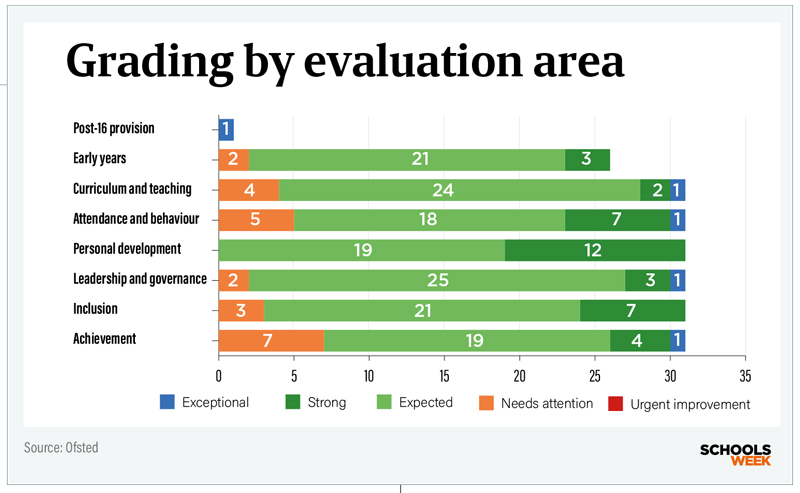
None of the schools have received the lowest ‘urgent improvement’ grade.
However, more than one-third received at least one ‘needs attention’ assessment. Eleven schools received this grade, across a combined 23 judgment areas.
The ‘achievement’ evaluation area received the highest number of ‘needs attention’ grades (seven). This was followed by ‘attendance and behaviour’ (five) and curriculum and teaching (four).
Just one school – Ashcroft Technology Academy, in Wandsworth – received ‘exceptional’, achieving the top grade across five judgment areas.
Ofsted has previously said the “likely three most commonly awarded grades” will be the middle three – ‘needs attention’, ‘expected standard’ and ‘strong standard’.
Special school in special measures
A special school has been placed in special measures after a damning Ofsted report saw it given ‘urgent improvement’ ratings across the board, and found safeguarding standards were “not met”.
Trinity Academy Newcastle is understood to be the first school rated in need of ‘urgent improvement’ or placed in special measures since the new framework was introduced.
It was not included in our above analysis of routine inspections, as Trinity’s inspection was triggered by a monitoring visit.
The latest report said that pupils “are not safe” and “wander around school when they should be in lessons”, with some leaving the building.
It also noted that “bullying, swearing, derogatory language, and aggressive and intimidating behaviour happen frequently”.
Persistent absence rates were 82.4 per cent in 2023-24 – more than triple the national average of 25.6 per cent. Overall absence was at 41.2 per cent, compared to an 8.9 per cent national average.
‘We don’t believe the judgment reflects current strength’
Ofsted’s report said the school required special measures “because it is failing to provide an acceptable standard of education, and the persons responsible for leading, managing or governing the school are not demonstrating the capacity to secure the necessary improvement in the school”.
However, the school has two sites, and inspectors found pupils at its lower site “attend school regularly … enjoy their learning and achieve well from their different starting points” while “skilled staff provide pupils with highly effective support”.
Trinity said: “While we respect the process, we do not believe the final judgment reflects the current strength of our provision, particularly the strong practice at Trinity Academy Newcastle Lower.”
Ofsted will now monitor the school.
Inspections will usually be termly, according to the new monitoring policy, although the number will depend on the extent of issues found. Schools in special measures can receive up to six visits within 24 months.









Your thoughts