

The abuse of headteachers over school phone bans is “completely unacceptable”, Bridget Phillipson told MPs last month.
The education secretary was responding to reports that one leader was “spat and sworn at” for implementing a ban.
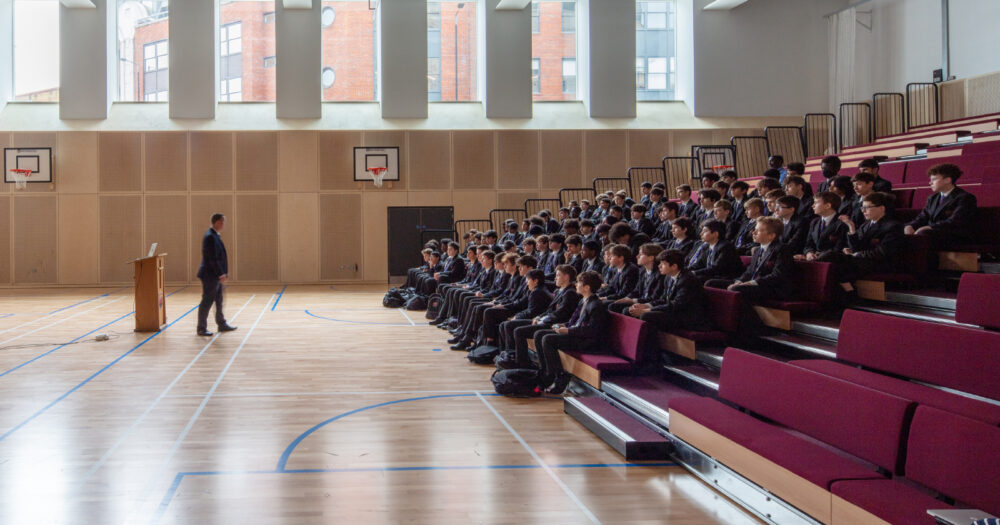
That leader was David Smith, the head of The Fulham Boys School in west London, which enforces what is thought to be one of the strictest restrictions on phone use in the country.
He explained his thinking to Schools Week, maintaining the ban is necessary, and calling on the government to step up and back headteachers.
The Fulham Boys School banned phones in September 2024. The ban is total – no smartphones on site.
“They can’t lock them in pouches, they can’t have them in lockers. They’re just not allowed them,” says Smith.
If a pupil is found with a phone, it is confiscated for six school weeks.
“And that doesn’t include school holidays,” says Smith. “I took a phone in June off a student and he didn’t get it back until October.”
But he believes a strong deterrent is essential.
‘Not about behaviour’
If pupils get their phones back for holidays, he argues, there is little to stop them using them in the final days of term.
The school’s previous policy allowed parents to collect confiscated phones, but Smith said this was “not fair”.
Better-off parents with more time on their hands could easily collect them, while for others “the phone was there for two weeks”.
The hardline policy is not about behaviour or attainment.

“It is because there is a moral piece, from our perspective, that young people are damaged,” he says. “And it could be irreversible if we don’t do something around smartphone use.”
Smith highlights dangers posed by social media and internet access, saying that to be a teenage boy today is “really hard”. Schools must “educate around” sex and misogyny before they are exposed to it.
“If [parents] want us to really do our job well and effectively, we need to get there first. We need to tell them why their bodies matter, their voice matters, their belief matters, before the world tells them.”
Overstepping the mark?
Some parents feel The Fulham Boys School is “overstepping the mark”, something that Smith rejects.
Schools already deal with issues that affect children outside school hours, such as bereavement, sexting and bullying, he says.
“It is our duty to care about every single aspect of a young person’s life while they are as part of our school.
“Do [parents] want a headteacher that’s fully bought into their child’s education and cares about them holistically? Or do they just want a babysitting provision where they hopefully get good results? They want the first, and in this school, they get the first.”
‘Parents can be aggressive’
Most parents have responded positively to the ban. But some “genuinely believe” that Smith is making their child’s life and their life significantly worse.
Some have shouted … “they’ve screamed. They’ve refused to leave the premises, we’ve had to call the police.
“I’ve had complaints to Ofsted about the policy…complaints to the police. Some parents can be aggressive.”

On one occasion – highlighted to the education secretary by Lib Dem MP and schools spokesperson Caroline Voaden in December – a parent spat at Smith.
“That was a one-off,” he says. “It was in anger, he apologised…it was fine.”
Smith said he feels “sympathy” towards parents who feel the school has “taken a limb” by confiscating phones, adding many are “used to parenting through a device”.
He absorbs the backlash. “I just say ‘blame me, this is my decision. It’s my school.’”
But he admits it means he has developed a “really thick skin”.
‘Government must legislate’
Smith believes the government should mandate phone bans to take the pressure off heads.
“Ultimately, if the government just said [pupils] shouldn’t have [phones], then we wouldn’t have to deal with the problem.”
Current non-statutory guidance says schools must have a phone policy “that prohibits the use of mobile phones…throughout the school day, including during lessons, the time between lessons, breaktimes and lunchtime”.
But a major survey by the children’s commissioner last year found wide variation in how restrictions are imposed. Ninety per cent of secondary schools restrict use, but only 3.5 per cent have a total ban.
The majority (79 per cent) allow phones on site if kept out of sight, while 3.9 per cent allow phone use at breaktimes.
However, heads remain divided on whether a government ban is needed.
It has repeatedly fended off calls for bans to be enshrined in law, despite entreaties from opposition MPs, and a failed bid by Josh MacAlister, then a backbencher and now children’s minister.
A Department for Education spokesperson said: “This government backs headteachers to take the necessary steps to prevent disruption.”
It pointed to the children’s commissioner survey, and to steps taken to protect children from harmful content through the Online Safety Act.
“We are striking the right balance: protecting children while ensuring they can safely benefit from the digital world, without risking isolation or cutting off access to vital services, especially to the most vulnerable.”
Phillipson has insisted leaders “do have the powers” to ban phones, with evidence showing they “are already [being] prohibited”.
But with schools told “left, right and centre what we should do” on issues from uniform to the curriculum, Smith feels it is “ironic” that phone rules are left to heads.
Parental concerns
Parents’ main concerns, says the Fulham head, are around “tracking and safety”.
A ParentKind poll of about 2,500 parents last year echoes those concerns. It found 58 per cent would support banning smartphones for under-16s.
But most (82 per cent) agreed it was important to be able to contact their child, while 61 per cent valued being able to see their child’s location.
The Fulham Boys Schools allows pupils to have certain “brick” phones, that can only be used to text or call.
But Smith believes parents “have to let go”.

“When their child is 25 [will they still be] tracking their whereabouts? When they get married, when they have children? …It’s not healthy.”
He does not let his own daughter to have a smartphone, despite her secondary school allowing them.
“I presume she’s at school. I presume she’s safe. I presume she’s well – maybe she’s not, but she’s safer without one, so I’ll take that risk.”
Smith acknowledges phones “are helpful”, but adds that “at worst, I’m adding a layer of inconvenience to someone’s life in order to safeguard them and their future”.
Changes in behaviour
Smith says the ban is working. In its first three months, phones were confiscated from 40 boys – around 5 per cent of the school’s pupils. A year on in the same period that total was six.
Since the ban, Smith says there has been a drop in boys “being unkind to one another online. They talk to you and they look at you in the eye.”
And incidents of child sexual exploitation, including grooming and sexting, reported to its safeguarding team have dropped 90 per cent.
A few months after the policy was introduced last year, some parents complained when they found phones would also be banned on the school’s annual ski trip.
Smith offered a full refund for parents who wanted to withdraw their child, but none took it.
At the hotel, Smith says his pupils were “playing card games with staff and enjoying their evening” while those from other schools were “sitting there on their phones”.
The day after Smith sat down with Schools Week, he was to take another 125 boys skiing to Italy. They would again not be allowed phones, including for the 18-hour coach journey.
“The boys and staff are just going to talk to each other.
“And when they get tired, they’re going to sleep…And that is lovely.”











As a teacher the best policy is a “phones on desk” approach. Mobile phones are simply modern technology, as teachers we should be teaching children how to use them appropriately and when it’s appropriate to use them. I operated this system and it worked, the most kids ever used their phones for was checking the time, reading the odd message (they know they had to wait until after the lesson to reply), using the calculator, taking pictures of work or examples. Don’t punish them for any of the above, if it is a constant checking the time or reading messages remove the phone for the remainder of the lesson; if they respond to messages in lesson, or are playing games, or doing anything else they should be confiscate the phone until the end of the day. Confiscating a phone for any duration longer than this is technically theft, by definition.