


Since founding Yondr in 2014, Graham Dugoni has been trying to build a “cultural movement” towards phone-free spaces. It’s already a pretty broad church.
After all, what else could possibly link former UK schools minister Nick Gibb, comedian Chris Rock and rock star Jack White?
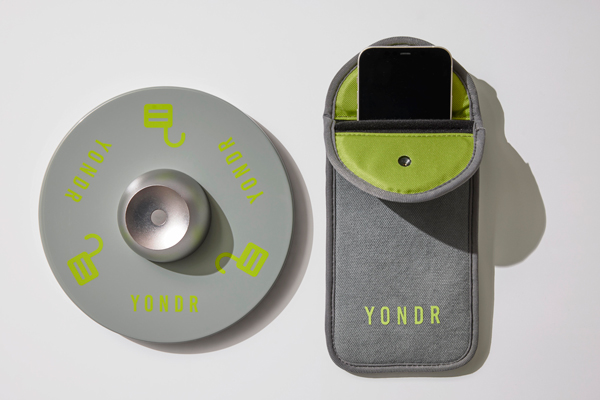
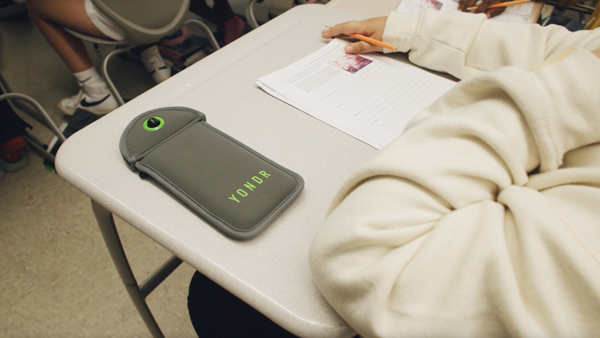
Yondr’s lockable pouches allow schools, concert halls and other venues to lock smartphones away but let their owners keep hold of them.
The company has operated in UK schools since 2017, but has experienced a recent boost in popularity.
More than 250,000 children in 500 schools now use the programme. Of those schools, 110 started in September.
Yondr also made headlines earlier this year with its surprise appointment of Gibb as an adviser.
‘I got laughed out of every school’
Born in Portland, Oregon, Dugoni attended Jesuit High School before playing college soccer at Duke University. He turned professional in 2010, playing for a Norwegian club before returning to the states, eventually retiring due to injury.
The sportsman, now 39, set up Yondr after seeing a drunk festival-goer being filmed without permission.
His concern about live events led quickly to worries about schools. But when he started trying to sell his invention in education, he faced pushback.
He says it was during a “tech boom” in San Francisco, at a time when the “zeitgeist” was for more tech inside the classroom, not less.

“I got laughed out of basically every single school for probably six months straight,” he says.
But he felt young people were “going to need to have the experience of being without these devices for at least a period of time every day.
“Otherwise, how are they ever going to learn to integrate them into their life in a useful way?”
When the company started it was “mostly individual schools or individual classroom teachers looking for some kind of solution,” Dugoni tells me over video chat from the US.
Now, “there’s broad social acceptance, I think, of what we do”, and Yondr works with entire multi-academy trusts here and whole states in the US.
Why pouches?
A survey by the children’s commissioner, Dame Rachel de Souza, found earlier this year that 90 per cent of secondary schools and 99.8 per cent of primary schools already had policies in place that stop the use of mobile phones during the school day.
Three-quarters of primary schools and 7.9 per cent of secondary schools reported requiring pupils to hand in their mobile phones or leave them in secure locations they cannot access.
Only 3.5 per cent of secondary schools fully banned pupils from bringing them in at all.
With schools locking phones away already commonplace, what’s the benefit of a pouch?
Dugoni says the approach “gives the student a sense of responsibility”. He adds: “The student keeps their property on their person, which is helpful when you’re talking to parents.
“But it’s also helpful when you’re trying to educate young people, as you’re saying ‘we trust you to keep your property, but throughout this period of time, you can’t use it’.”
‘You have to interrupt an impulse’
Another benefit is that when a pupil reaches for their phone and feels the pouch, “it interrupts the mental impulse.
“To me at the deeper level of phenomenology, how you’re going to retrain students and create new habits, is you have to interrupt an impulse and allow a new neural pathway to form.”
Dugoni acknowledges some “dynamo” heads have been “doing this for a long time”, creating an “amazing school culture where they’re able to create a phone-free school from beginning to end of the year”.
“The vast majority of districts and schools we work with around the world are trying to do that. But somewhere along the school year, that process drops off,” he adds.
“In a lot of these systems, the teacher’s kept in the position of being the phone police… the ones who have to wade through the grey area of, ‘is it a valid reason the student has their phone or is it not?’.”
Is it value for money?
Yondr’s pitch to schools is a tricky one at a time of financial hardship.
Its programme costs £18 per pupil – that’s for the equipment, but also the implementation support, data analysis, help with communication and staff training.
An average-size secondary school in England would face a bill of over £19,000 to implement it for all pupils.
And the combined bill for the 500 UK schools using Yondr pouches would total £4.5 million. Schools also pay £15 to replace lost pouches.
What may have started as an altruistic drive to improve pupils’ wellbeing and learning has turned into a huge for-profit company operating across multiple countries.
Yondr is a private company registered in the US, so its financial results are not published. But its sales to state schools in the US alone reportedly increased from $174,000 in 2021 to $2.13 million in 2023.
And it was recently reported that Yondr made $5 million from US government contracts in the first three quarters of 2024 alone. The company says it expects double-digit revenue growth in education this year, and its business has grown nearly five-fold since 2023.
‘I didn’t start the company for it to become a business’
So are pouches value for money, when other approaches may be cheaper or free?
Dugoni says that if creating phone-free schools was “as easy as I think sometimes someone, a casual observer, thought it was, Yondr wouldn’t exist.
“When you get down to these societal problems and start pulling them apart, to actually make something work and stick for a school, it takes some knowhow, and it takes some support.
“Our perception is that teachers are already working hard or are overworked. They’re stretched and they’re trying to wrestle with something that’s woven through every student’s home life, through their personal psychology, and then through the school ecosystem.”
On the for-profit element, Dugoni adds: “I don’t shy away from that. But I didn’t start the company for it to become a business. I did it out of what I saw as this social counterculture that needed to develop and grow.”
The benefits of a ‘ban’

The rise of solutions like phone pouches is set against the backdrop of a fierce debate over whether the UK government should mandate a ban on phones in schools.
Ministers say a full statutory ban isn’t needed because most schools already restrict phone use.
The Conservative Party now wants a full ban, despite opting not to put one in place during 14 years of rule.
Dugoni says having “legislative tailwinds massively helps in the US”. He mentions Arkansas and New York, which recently implemented state-wide bans.
He says these moves have been “incredibly beneficial because it gives school leaders and communities a sense that, yes, we wanted to do this, but now there’s some higher level support for what we’re doing”.
But he says most now talk about being “phone free”.
The difference is “really important, because phone ban is something negative. It’s like students are doing something bad”.
Schools going phone-free often face a mountain to climb with getting pupils – and their parents – onside.
For example, it might become a source of anxiety for parents who have got used to being able to communicate with their children throughout the school day.
A way to discuss other issues with parents
But Dugoni argues making schools phone free gives leaders the opportunity to talk to parents about wider worries, such as those explored in the recent hit Netflix drama Adolescence about a teenage boy who murders a girl from his class.
It’s a “way to start to talk to different types of parents and say, ‘hey, all these things that you’re worried about, your kid scrolling on Tiktok 24/7, online bullying. These are big, nebulous societal problems’.”
Also, for parents who text their children throughout the day, “some of those social norms have to be unwound a little bit, so that the parent knows that when [they’re] doing that it’s actually incredibly disruptive to the learning environment”.
Dugoni has deep broader concerns about the use of technology, particularly artificial intelligence.
He describes phones as the “most hyperbolic expression of the themes we’ve been talking about, but it affects all modern, especially digital technology”.
He sees a pattern of students “becoming totally and utterly – or even people of all ages – really reliant on AI”. Yondr has blocked AI tools on its email servers and other systems.
“The main reason was I want our team to develop. I want them to maintain the ability to think critically, to write well, have their personal voice come through.”
Ex-ministers and stars backing phone-free spaces
So how does Nick Gibb fit into all this? He served as schools minister for around 10 years across three different terms and is credited alongside Michael Gove with steering Conservative education policy for around three decades.
When he announced he was quitting Parliament at last year’s election, Gibb was hoping for a diplomatic post. How did he end up advising a company that makes phone pouches?
“I think when you meet people who are really sharp and really passionate about helping kids achieve their potential, fundamentally, that creates a lot of overlap in our goals,” says Dugoni.
“And when I first met Nick, that’s what I picked up on. Here’s someone who’s vastly experienced in the education world, who cares about the same things that I do. I would say that’s true for everybody that we work with.”
Much of Yondr’s work is outside education – its phone pouches are promoted by prominent musicians and comedians to improve the experience of their gigs.
“There’s a similar thread between, I would say, the Chris Rocks, the Jack Whites, the Dave Chappelles, to the Nick Gibbs.
“There’s people who are paying attention in society, and they’re trying to help, basically. And that’s honestly how I view Yondr, as part of this cultural movement.”








Your thoughts