


A special school headteacher has accused Ofsted inspectors of lacking the “contextual experience” to judge special needs provision after they criticised achievement in phonics despite most younger pupils being unable to talk.
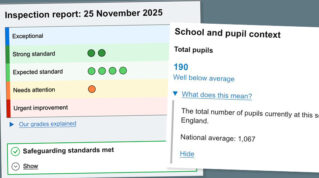
Ofsted did not uphold a formal complaint from Newman School in Rotherham, which supports pupils with complex needs, over an “inadequate” judgment published this week.
As well as contesting safeguarding findings, headteacher Paul Silvester said phonics criticism was “inappropriate” as many pupils are “unlikely ever to speak”.
Ofsted’s inspection handbook says inspectors consider whether leaders are “ambitious for all pupils with SEND” and how leaders “develop and adapt the curriculum”.
But Silvester said inspectors had “little or no contextual experience” of SEND schools, which contributed to the downgrading.
The inspection was conducted by two Her Majesty’s Inspectors (HMIs) and one Ofsted inspector. Neither of the HMIs’ pen portraits on the Ofsted website refer to SEND experience.
A Schools Week analysis of the 228 schools HMI pen portraits – descriptions listed on Ofsted’s website of sector experience – found just 13 (6 per cent) listed working in a setting for SEND pupils.
But Ofsted said all inspectors get routine SEND training. All HMIs and inspectors visiting special schools must also complete “additional specialist enhanced SEND training”.
‘Some kids are unlikely to ever speak – this is not because of our phonics’
Inspectors found safeguarding arrangements at Newman, an all-through school formerly rated “good”, were not effective and raised concerns about curriculum and behaviour.
Procedures for “identifying and recording concerns that pupils may be at risk of harm … are not robust”. Some staff did not have “sufficient knowledge of the risks that pupils may face”.

Silvester lodged a formal complaint. He claimed inspectors’ lack of SEND experience contributed to the downgrading as they did not appreciate the school’s context.
He pointed to inspectors stating pupils “do not consistently achieve as well as they could in reading and phonics” and some older pupils “still struggle to read”.
The headteacher felt this was “inappropriate” as three-quarters of primary age pupils at the school can speak only 10 words or fewer.
“Some of my kids are unlikely ever to speak, so unlikely ever to read – that is not because of a phonics programme,” he said.
However, the report had found an inconsistent approach for assessing knowledge gaps for “pupils who are able to make academic progress”.
The school commissioned an independent safeguarding review from the National Society for the Prevention of Cruelty to Children. It was more positive and concluded school leadership was “an excellent example of safeguarding teamwork”.
But Ofsted did not uphold the complaint, it said the lead inspector had “completed all Ofsted’s mandatory SEND training”.
Ofsted say inspectors are “curriculum experts, able to evaluate the quality of education in any setting.”
‘SEND training is not the same as SEND school experience’
Of the 228 school HMIs with pen portraits on Ofsted’s website, fewer than one in five refer to SEND in some way – either training, expertise or inspection knowledge. Just 13 mention working in a specialist setting.
Further analysis of 20 recent special school visits found that seven were conducted by HMIs with no SEND expertise listed. This included six section 5 graded inspections – four of which resulted in “inadequate” grades.

Adam Boddison, former chief executive of the National Association for Special Educational Needs, said it was “essential that Ofsted inspectors have significant knowledge, skills and experience of SEND” to “make accurate judgments”.
Ofsted could not say how many of its inspectors had worked in SEND schools. But it said “enhanced” training for inspectors of SEND schools, which includes an annual refresher course, “ensures that all special schools are inspected by an appropriately trained inspector”.
Pen portraits were “simply snapshots” of an HMI’s career and “not meant to be exhaustive lists” of areas of expertise.
A watchdog spokesperson said inspectors who conducted the analysed inspections all had up-to-date SEND training, including new modules on communication with SEND children and understanding their family’s experience.
Special schools face ‘coin toss’ on inspectors
But Silvester warned “experience level is not the same as training level”.
A SEND leader from the north of England, who wished to remain anonymous, said the lack of special school experience among inspectors was “deeply worrying”.
Schools faced a “coin toss” on the level of experience an inspector will have.
“If you aren’t inspected by people with the lived experience of the work we do, there’s a serious risk for Ofsted that they’re going to introduce individual biases.”
Silvester said inspections of SEND provision should only be conducted by inspectors with relevant experience.
Boddison cautioned against this but said training on its own was “insufficient”. He urged Ofsted to “seriously consider introducing a SEND capacity-building programme” to give inspectors “direct experience and insights into effective SEND provision”.











Amanda Spielman in her address to ASCL talked of the importance of ‘professional dialogue’ . This can only happen when inspectors have appropriate experience.
We have also asked how many inspectors who inspect early years settings have early years experience. Too much time in schools and money is spent preparing for OfSTED and also for tests and exams. This does not achieve results and is the reason many children and young people are bored. They do not learn this way. The proposed focus on literacy and numeracy will make matters worse. The curriculum needs to be exciting, creative and practical.
Phonics is not the only way to teach reading and does not work for many children especially those with SEND.