


Schools will no longer be publicly compared to the national “average” for their progress scores in a proposed overhaul of government league tables.
Instead, ministers are proposing that schools be listed based on percentiles – so for example, they might be in one of five “quintiles” for pupil progress.
The Department for Education has also fleshed out details on how a proposed new “best fit” progress score for low prior attaining pupils could work.
Under proposed reforms, league tables would also show the proportion of pupils achieving a grade 7 or above in English and maths GCSE, with breakdowns for key pupil groups.
New ratings for progress scores
Currently, schools are given progress scores based on how much pupils improve during primary school, between primary school and GCSE and between GCSE and A-level.
They are currently listed based on “confidence intervals”. These are “well below average”, “below average”, “average”, “above average” or “well above average”.
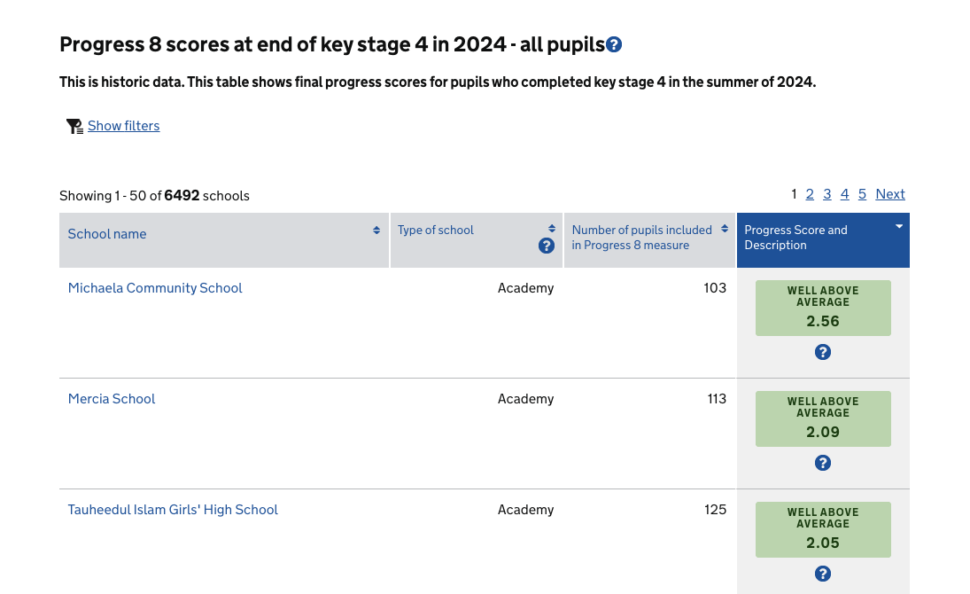
But in a consultation launched yesterday the government said the “methodology is complex and we know it is poorly understood”.
For example, it can “lead to labelling a large proportion of schools as ‘average’ and therefore limits users’ ability to differentiate between performance”.
“Currently, if a confidence interval includes zero (the national average for progress), then a school or college is labelled ‘average’.”
This means that two thirds of schools at key stage 2 and 43 per cent at 16 to 18 are “average”, though the figure is a third for key stage 4.
Bandings can also be impacted by school size. The smaller a school, the larger the confidence interval, “meaning smaller schools need to achieve higher progress scores to be labelled ‘above average’.
“Therefore, a school can achieve a higher progress score than another but be assigned a lower banding.”
From averages to percentiles
Instead, the government is proposing to continue to rank schools in order of progress score, but to assign bandings based on percentiles.
“For example, if using quintiles, this would mean assigning the top banding to the 20 per cent of schools with the highest progress scores in a year.
“This simpler approach will also ensure we have a more useful spread of bandings to differentiate between performance.”
However, it is “still important to reflect the uncertainty in progress scores”.
The DfE is therefore proposing to present three years of progress scores and bandings, along with cohort size and pupil characteristics and a “short pop-out box explaining the uncertainty due to cohort size”.
It will then link to a technical document outlining the “uncertainty inherent in all performance measures”.
“We think that presenting uncertainty as outlined above will add more value to the progress measures. We are planning to implement this across all key stages, with the first being the return of progress measures at key stage 2 in December 2026.”
New progress measure for low prior attainers
The government also announced yesterday that they would consult on a new performance measure for key stage 4, in addition to progress 8, focused on the “progress made by pupils who enter secondary school behind their peers”.
In the consultation, the DfE said it was “considering whether we could spotlight the performance of the low prior attainers (LPA) cohort via a bespoke ‘best-fit’ progress measure”.
The government already allocates pupils to prior attainment groups based on their key stage 2 results.
It is proposing to calculate a new, additional measure for those in low prior attainment groups.
The DfE would then calculate progress scores for each pupil starting with a score for maths, at least one English GCSE and their best subject.
It would calculate an additional progress score for every extra subject sat by a pupil and take their best progress score to calculate the new measure for the school.
“Using pupils’ best progress scores will encourage schools to enter them for as many qualifications as they feel appropriate for each pupil, without a penalty for empty slots, but also without an artificial cap or limit on what a pupil can attempt,” the DfE explained.
Adjustment could better reflect EAL starting points
Government could also make an adjustment to the baseline used for pupils with English as an additional language (EAL), taking the higher of their average score in reading and maths at the end of KS2, or just maths.
The adjustment “would ensure that EAL pupils are assigned to prior attainment groups that are more reflective of their academic starting points”.
“It would mean approximately 31 per cent of EAL LPA pupils would move out of the low prior attainment cohort and would lead to fairer comparisons and progress calculations for pupils remaining in the LPA cohort.”
The consultation also sets out plans to adjust which additional academic measures the government publishes in league tables.
This will include a new attainment measure showing the proportion of pupils getting a grade 7 or above in English and maths GCSE.
There will also be additional breakdowns for key pupil groups, and a metric showing the proportion of disadvantaged pupils achieving certain grade thresholds compared to national and local averages.
The government is also consulting on previously-announced plans to reform the progress 8 key stage 4 performance measure in a bid to encourage uptake of a broader range of subjects.











Your thoughts