


Dozens of struggling schools enrolled in a £20 million turnaround scheme have been paired with experts based up to 269 miles away.
Schools Week analysis found around one in 10 schools in the government’s Regional Improvement for Standards and Excellence (RISE) programme have been paired with advisers based in different parts of the country.
The findings have sparked concerns that the support provided through the flagship school improvement scheme risks becoming “a desktop exercise with a Zoom call”.
The “targeted RISE” scheme was launched last year and Its 65-strong team of advisers – leaders seconded to work alongside officials – are appointed to specific schools, usually in their region, to identify priorities and propose an outside organisation to provide support.
The programme is focused on ‘stuck’ schools, those rated ‘requires improvement’ by Ofsted following an earlier inspection that resulted in a grade below ‘good’.
Schools Week analysis of Department for Education data, obtained through the freedom of information act, shows that of the nearly 430 schools enrolled in the RISE intervention programme, 46 have been matched with an adviser outside their region.
Twelve of the 46 are more than 100 miles from their RISE adviser’s school or central team offices, our figures suggest. Three are over 200 miles away.
St Chad’s Roman Catholic Primary School in Manchester (269 miles) is the furthest from its adviser. It is over four hours away by car, according to Google.
‘Desktop exercise with a Zoom call’
Sir David Carter, the former national schools commissioner, noted that “where distance is an issue the support becomes a desktop exercise with a Zoom call to present the challenge”.
He added: “Whilst the role may be a diagnostic one, I fail to see how you can build the confidence of the leaders and governors at the school being supported if you cannot get a glimpse of the culture and the daily typicality of how the school works.”
Our analysis shows 19 advisers are working with schools in a different region. Four of those advisers are based in London.
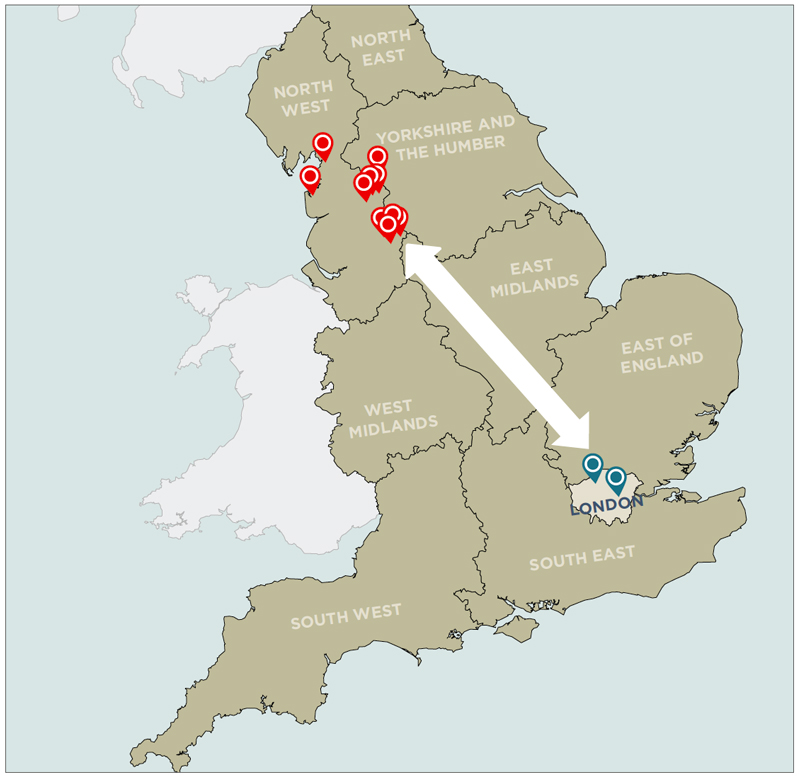
London has the most advisers (nine) and the fewest RISE schools (11).
Policy expert Loic Menzies argued the “education system has long suffered from geographic disparities in improvement capacity”.
He said “one of the biggest tests for RISE” would be its “ability to work with trusts to nurture expertise and capacity in every corner of the country”.
Department for Education guidance says targeted support “will be bespoke and tailored to the specific challenges facing each school”.
‘A national team framework’

RISE teams will coordinate with leaders to “arrange interventions from a high-quality organisation, such as a strong local trust and will have access to funding to facilitate improvement activities”. The divisions will monitor progress termly.
And speaking last year, the then director of regions group John Edwards said RISE would draw on capacity “through a national team framework to make sure we can achieve the most locally, to improve those schools who need it most”.
Oliver Burwood, chief executive of the Diocese of Norwich Education and Academies Trust, said that a “fresh perspective from outside your region may not be a bad thing. But what you do probably need is a knowledge of feasible, quality local providers.
“If you do not know who those organisations are, are you in danger of suggesting people who may be contextually very different?”
Timing, travel and knowledge difficult
A government-commissioned evaluation of the RISE targeted support service, focusing on the first 223 stuck schools given help, merely identified “a few cases” where advisers were matched with schools outside their geographic patches.
It accepted this made “made timing, travel and aspects of contextual knowledge more difficult”.
One adviser didn’t “know anything about the two trusts” as they were in a different county, and found it “really hard” to know whether their suggestions were right. The adviser was left “hoping the DfE and their regional teams know that a little bit better”.
Victorious Academies Trust said the support one of its schools, Wild Bank Primary in Tameside, Greater Manchester, receives has been “very positive”. Its adviser, Inspire Partnership CEO Rob Carpenter, is based over 200 miles away in London.
Despite this, he has “always” travelled to the school in person and “arrives early in the morning, ensuring we have ample time for meaningful discussion and guidance”, Victorious said, adding: “His commitment has meant that the physical distance has never been a barrier.”
‘Not meant to answer everything’
One adviser, who did not want to be named, argued the distance of some advisers from the schools was “not a big issue”.
They reasoned advisers are not meant to be the “answer to everything and working in isolation” as they simply provide recommendations to civil servants in the regional teams.
The RISE evaluation said the early evidence suggests “targeted intervention was broadly successful in terms of engaging schools and partners”, with a “range of lessons” learned during its full academic term.
A DfE spokesperson said the advisers “are among the most skilled school improvement professionals in the country”, adding the department’s staff “deliberately draw on expertise from across England to ensure the best possible match”.
“Spreading advisers geographically means schools benefit from a breadth of experience and fresh perspectives, rather than being limited to their local area,” the spokesperson added.
The evaluation report found that “a few supporting organisations raised the issue of distance”.
Data on partner organisations patchy
In one case, a trust chief executive said they had been asked to work with a school that was “more than a two hours’ drive away”. They subsequently decided “they would not be able to adequately support this school”.
Other supporting organisations said a one-hour journey “was the maximum”.
One adviser told of how one of their schools “was based across a regional boundary, where there was a complex, competitive relationship between trusts”.
This precluded “the selection of the ideal match” as other MATs in the area would “kick off”.
As part of the programme, advisers can pair schools with supporting organisations, usually academy trusts.
However, government data on where trusts are based is patchy. It also does not stipulate whether chains operate across a number of areas.
A trust chief executive, who asked to remain anonymous, added: “School improvement is most effective when it understands local context – communities, labour markets, and the challenges schools face in different parts of the country.
“London clearly has a deep pool of experienced system leaders, but the success of RISE will depend on drawing on expertise from across the country so that support feels credible and rooted in place rather than centrally directed.”










Your thoughts