

Schools should stock spare allergy adrenaline pens, government has proposed in new landmark guidance, but unions have warned this should be met with sufficient funding.
The Department for Education has opened an eight week consultation on draft statutory guidance for allergies and medical conditions.
It follows campaigns to improve allergy safety in schools after the death of five-year-old Benedict Blythe, who died from an anaphylactic reaction at his school in Lincolnshire in December 2021.
Benedict’s parents and campaigners for the guidance Helen and Peter Blythe said it was a “true turning point” for allergy safety and awareness in schools.
Early education minister Olivia Bailey is reported to have said schools will be expected to pay for the allergy pens out of their core budgets.

But Daniel Kebede, general secretary of the National Education Union, urged the government “to provide additional funding to cover this as the devices need to be bought from pharmacies and regularly checked against expiry dates.”
Paul Whiteman, general secretary of school leaders union NAHT, added that government needs be “confident that there are sufficient stocks maintained across the country”.
The DfE said in general, each school should purchase four spare pens. This works out at about 85,000 needed to cover primary, secondaries and special schools.
The guidance will form an amendment to the childrens wellbeing and schools bill, which will go to a vote on Monday.
The full 122-page draft guidance is here. But here are the key points…
1. Mandatory spare allergy pens
The DfE said anaphylaxis reactions are unpredictable and up to 20 per cent happen to children without a pre-existing diagnosis.
Schools should stock four spare adrenaline devices for use in an emergency, for example if the pupil’s own devices are not available or misfire.
They can also be used on pupils with food allergies who have been assessed as lower risk without a prescription, but medical authorisation and parental consent must have been obtained.
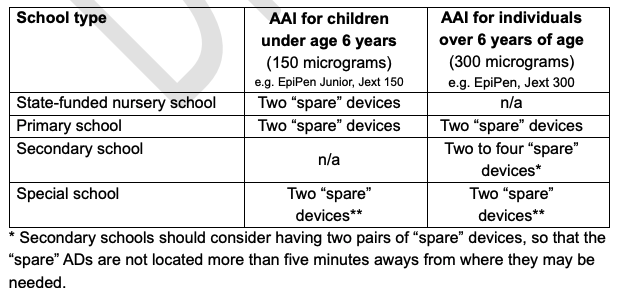
Regulations do state a school’s spare devise can be used on anyone experiencing anaphylaxis for the purpose of saving their life.
The DfE states this provision “should be reserved for exceptional circumstances only, that could not have been foreseen”.
Spare devices should be accessible at all times and in a safe and central location, like the school office or staff room.
The DfE said it will put out an open call to businesses to support with costs.
They can be bought from a pharmaceutical supplier, such as a local pharmacy, without prescription. A supplier will need a request signed by the principal or headteacher including specific details.
In a case of anaphylaxis, adrenaline should be administered within five minutes.
2. Compulsory staff training
All staff should receive annual allergy awareness training. It should cover all staff, including teaching staff, support staff, catering staff and others who may oversee pupils at breakfast or after school clubs.
Information it should cover includes identifying the main food allergens and reaction symptoms and knowing how to administer adrenaline or an inhaler.
It should also include how to report an allergic reaction.
For wider medical conditions, training should be “sufficient” to ensure staff are “competent and have the confidence in their ability” to support pupils with medical conditions.
Staff will need to understand the specific medical conditions they are asked to deal with, but a first-aid certificate does not constitute appropriate training.
3. Allergy policy requirement
Schools should create an allergy safety policy. The DfE will provide a template “shortly”.
Ofsted will consider these policies and their implementation during an inspection.
The policy should include key information such as how a school will identify pupils with allergies and minimise the risk of exposure.

Good practice includes having two “robust methods” of identifying pupils with known allergies at mealtimes, such as coloured lanyards.
Staff should consider items such as play dough, which can contain wheat flour, and glues which can contain milk, wheat or soya.
Other details include how staff will be trained in allergy awareness and emergency response and how the allergy would be managed on school trips.
A similar policy should be drawn up for medical conditions.
The policy should also include clear procedures to be followed for managing and storing medicines, including prescriptions and controlled drugs.
4. Safety drills
Good practice includes carrying out a “allergy safety drill,” like a fire drill.
For instance, a simulated anaphylaxis case could be used to test out how staff respond without risk to anyone.
The result should be recorded in a similar way to an incident or near miss and used to inform the ongoing review of the allergy safety policy.
5. Individual healthcare plans
For some pupils with medical conditions, an individual healthcare plan is necessary.
Draft guidance states it is ultimately up to a headteacher to decide whether a pupil will need a plan, or whether they can be supported through a school’s wider medical conditions policy.
Plans include a summary of a pupil’s medical conditions with triggers, symptoms and treatments, needs arising from the medical condition and how it can affect their wellbeing.
It should outline how a pupil can be supported on trips and what to do in an emergency.
Plans should also include their allergy or asthma action plan, which is issued by a healthcare professional.
6. Serious incidents or near miss recording
The guidance states that however effective a school’s policies are “they can never remove the risk of a serious incident”.
Schools should also record “near misses”, including what happened, when and where and why and how it occurred, along with who was affected.
They should also note how staff and students responded, what was done to support the person and whether emergency services were called.
The governing body and senior leader should then review the report and consider whether any rules were broken.
Some incidents may have to be reported to the Health and Safety Executive.
7. Emergency situations
For pupils with medical conditions, schools must have arrangements in place for dealing with emergencies.
This could include considering whether other pupils can play a role in informing staff if they think help is needed.
“In general, the consequences of taking no action are likely to be more serious than those of trying to assist in an emergency”, it states.
Schools should consider who will act in an emergency situation, including who supports the individual, who calls emergency services and who will contact the pupil’s family.











Your thoughts