

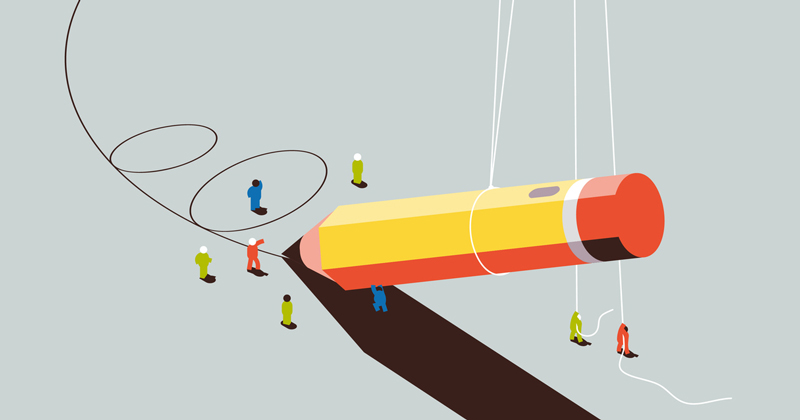
Competition between trusts, disconnected resources and no duty to collaborate mean it’s no surprise children fall through the cracks, says James Stuart
I’ve just returned from an inclusion conference, and I’m frustrated. It was full of committed people, but missing the one conversation we urgently need about the system.
After years as a teacher, head of a pupil referral unit (PRU), Ofsted inspector and now in local government, I’ve seen inclusion from every angle. And right now, the system is crying out for something we still lack: a way to work together.
Suspensions are rising. More pupils are out of school. The SEND system is in crisis. And everyone is rightly calling for “inclusive schools”. But we avoid the elephant in the room – fragmentation – and its impact on inclusion.
Academisation has created a landscape of silos. In one authority I’ve worked with, eleven secondary schools were run by ten MATs.
Resources are disconnected. Competition shapes decisions. Trust-level policies, however well meant, can create environments which push some children out of learning.
Systemic, not school-based
Every headteacher describes their school as “inclusive”. But in reality, inclusion varies.
As a result, pupils in PRUs, in home education or in education otherwise than in school experience inclusion very differently.
Some receive every intervention, while others drift through rigid systems until they reach the exit – or leave via the back door.
So how do we keep pupils in learning before they leave us and encourage them back after they’ve left?
The answers are systemic, not school-based. To keep pupils in learning, partnerships should set shared standards and take collective responsibility. But without expectation or accountability, too few do.
Schools that are already working at the limits of inclusion don’t need more lectures, local authority guidance documents or therapeutic mantras. They need a local system with earlier assessment and intervention. They need multi-agency, place-based support and high-quality alternative provision.
But these are place-based, not trust-based. And because multi-academy trusts control the microphone – in policy, leadership culture, in the endless stream of books and podcasts – this reality isn’t being addressed.
Partnerships are the answer
Meanwhile local authorities, the only organisations legally responsible for the whole picture, are overstretched, underfunded, and expected to hold everything together on a shoe-string.
Partnerships are the answer. Proper collaboration can reconnect capacity.
Between those 11 secondaries, 10 trusts and a local authority, it might be possible to create strong education outside schools for pupils with emotionally-based school avoidance, vocational KS4 pathways, shared specialist teams, and consistent early intervention models.
Inclusion cannot be delivered by individual schools or trusts. It is a system responsibility, and systems only work when the parts connect. But there is no incentive, legislation or regulatory expectation requiring the system to work together.
However, there is hope. Partnerships like Portsmouth Education Partnership and Raising Wiltshire are already working towards this. They prove this can be done.
So why isn’t everyone doing it? Official guidance talks of “working together to safeguard children”. Perhaps we need to similarly talk of “working together to include”.
A national framework for inclusion partnerships
If we are serious about inclusion, we need a framework that:
- Defines inclusion locally, with shared expectations
- Creates collective accountability across all providers
- Tracks and supports children who disappear from view
- Enables MATs and LAs to pool capacity
- Requires collaboration, not just encourages it
We need a national expectation that compels partnership, aligns accountability and reconnects the fragments of our system for the children who need us most.
Without it, well-intentioned guidance will remain beyond the reach of schools and beyond the capacity of LAs. More children will continue to lose learning.

Your thoughts