
Last year, the then Conservative shadow justice secretary Robert Jenrick prompted a fierce backlash when he described an area of Birmingham as “one of the worst integrated places I’ve ever been to”, and “as close as I’ve come to a slum in this country”.
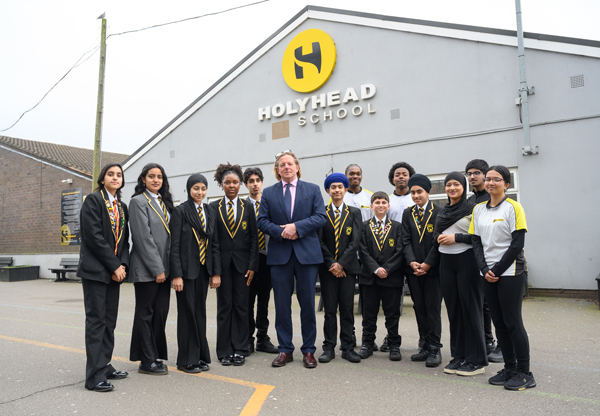
My recent visit to Handsworth, with Central Region Schools Trust CEO Guy Shears, painted a different picture. On its bustling main road sits Holyhead School, our destination.
As we approach the secondary school, Shears says visitors encounter “something very different” to what Jenrick – now a leading politician in Nigel Farage’s Reform UK – described.
Instead they see “a school with a strong sense of community, full of joy, respect and a great sense of fun, where diversity is celebrated and everyone is welcomed”.
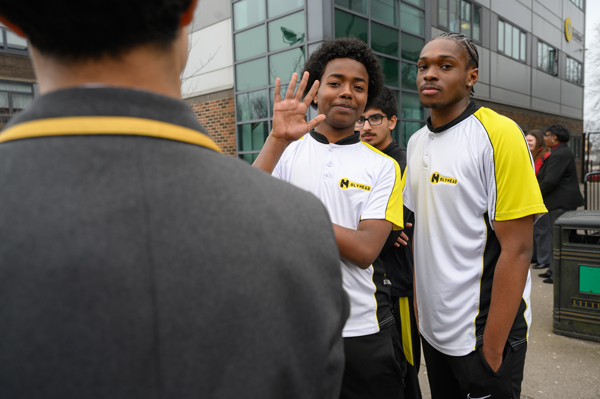
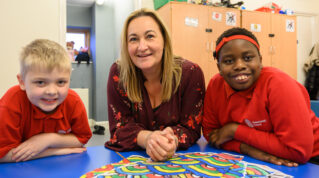
As we tour the grounds and buildings this rings true. Pupils are models of politeness, holding doors for visitors, and are excited to greet and talk to Shears (and to pose for our photographer).
Desperate state
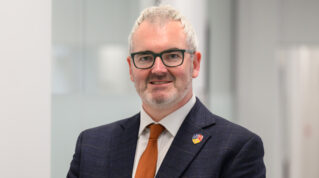
Shears, also an Ofsted inspector and a member of a government academy advisory board, has led his trust since it formed in 2012 from the academisation of Arrow Vale High School in Redditch, Worcestershire.
He had recently become its headteacher, and the school was in a “desperate state”, with a £1.2 million deficit and an intake far below its capacity.
There was a fire on his first day and when he went onto the playground “there were a good 60 children smoking. The deputy told me, ‘we don’t go down there’”.
After three months, the local council told him it would close the school.
“I gave them half an hour as to all the reasons why that wouldn’t happen, because we had plans, which have luckily been successful,” he says.
Due to its grades, the school was eligible to become a sponsored academy. Its governors were “fiercely” against it. Shears was “pretty ambivalent”, but had worked with the Royal Society of Arts group of academies before, and saw an opportunity.
After a persuasive meeting with then RSA director of education (now head of the Education Endowment Foundation) Becky Francis, the governors chose academisation over closure.
“I’m one of the very few heads, I imagine, who has taken their own school into a forced re-brokerage with a sponsorship,” says Shears.
It was still the early days of the academies programme, and there were “seven lawyers in the building for months”.
“I was interviewed for my own job by a panel in Sanctuary buildings who were really fierce, and then were delightful afterwards,” he recalls.
Arrow Vale is now over-subscribed, says Shears. It was rated ‘outstanding’ in 2014 and again in 2018. Its latest report in 2024 noted leaders had taken “effective action to maintain the standards identified at the previous inspection”.
The trust now has 14 schools in the West Midlands. Half have been intervention projects “of one form or another”.
Moaning about life
Born and raised in Birmingham, Shears studied geography at university but stumbled on teaching by accident.
He’d been working as a lorry driver and living in Australia. When he returned he worked at the Martineau Education Centre, where the local education authority was based.
He’d seen an advert for the PGCE at Birmingham university, and he would often overhear education staff when he was working on reception.
“The level of moaning… moaning about children, about life in general, I genuinely thought, goodness me, if that’s what our children are getting, then that’s quite alarming.” He decided to do a PGCE.
He stayed in Birmingham, training at Swanshurst School and then joining its staff. He quickly became head of geography and later assistant head.
It was an exciting time to be involved in school leadership.
At the time, the city’s director of education was Tim Brighouse, who later led New Labour’s London Challenge school improvement programme.
Shears says Brighouse was “truly inspirational”. He set up school networks in different parts of Birmingham, some of which survive in some form to this day.
Those networks showed “without any structural intervention, the power of collaborative work”.
“The city was quite disparate,” he recalls. “Bringing people together, helping each other, is something that I guess, on reflection, is now sort of formally structured into what is a multi academy trust.
“But that notion of genuine collaboration as public servants for each other and the school down the road is something that I really strongly believe in.”
Larger trusts
The government has said it wants to see all schools in multi-academy trusts. Shears believes this would be “desirable”, though there are “barriers”.
“I think it’d be a good thing for schools to join together. It will be interesting to see
what happens. There’s clearly some sort of preference for larger trusts. So I think we’re in interesting times.”
The barriers are twofold, Shears believes. One is the “waifs and strays” – very small schools with big deficits and old buildings with no rebuilding plans.
“I think we may end up with the vast majority of schools in trusts and then outliers that somehow there needs to be some sort of solution for.”
The other risk “is that there are trust boards seeking to offload the most challenging schools through the accountability structure”.
He says this is linked to the “weight of accountability that comes down, rightly, where a school’s been inadequate”.
“I’m not saying we should accept inadequate schools. Of course we can’t,” Shears adds.
The Central Region Schools Trust now has four secondaries, eight primaries and two middle schools.
The government opted not to state in its white paper its preferences on trust size. But the financial constraints of the last few years have made many smaller and medium-sized trusts consider mergers or expansion.
“We’re 7,321 pupils. And I think if you roll it forward three to five years with funding constraints, that starts to sit on the ‘probably too small’ side,” says Shears. But he is unsure if the government has a “sweet spot” in mind.
“I would have thought around 10,000 pupils, in order to do a great job for the children that you serve, is quite possibly where it may end up. I don’t know. That’s how it feels to me.”
He adds the trust has always been “cautious” about moving at speed.
“I’m talking to colleagues in other MATs where they’ve added five schools in a short period of time, and they all describe it creating turbulence.”
Serve all children
Leaders have for weeks been poring over the government’s proposed SEND reforms, which aim to make mainstream schools more inclusive.
Shears praises the white paper’s “excellent intent around special educational needs in particular”, especially given the “known behaviours of some schools in terms of not serving the community”.
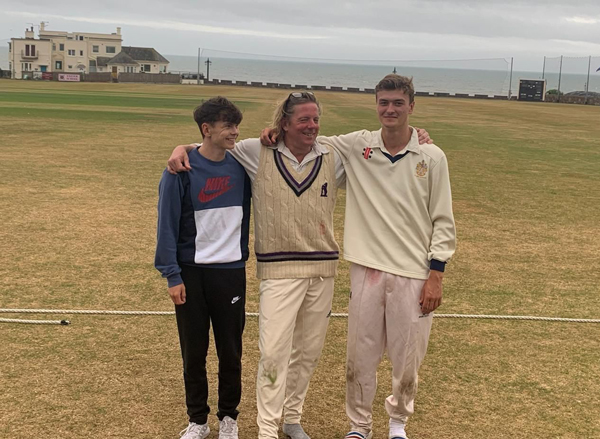
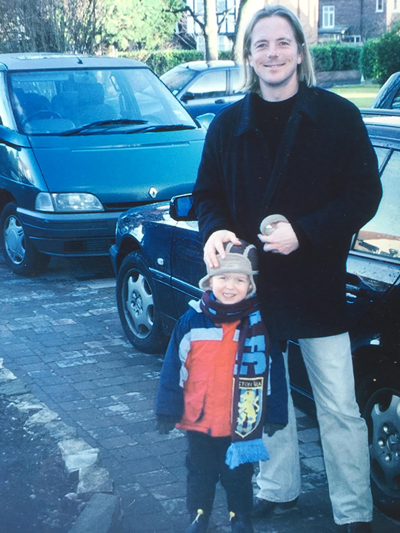
With sons Felix and Dexter after his last cricket century at Sidmouth
He adds: “It’s well known that there are all sorts of devices that schools will operate to push away families. We do the opposite of that, and this carries some risks. But we as a founding principle seek to serve all of the children within our gift.”
The white paper proposes a clampdown on off-rolling, but when it comes to children with SEND, Shears believes it is “more a matter of not on-rolling”.
“The battles that some parents have to get the provision that their children deserve are really heart rending, and it’s not OK. We’re public servants. That’s what we are.
“We serve the children of the country, and if they’re in your community, then you should be letting them in.”
Power of language
Shears also chairs a “RISE community of learning” made up of 40 school leaders in the West Midlands. Part of its role is to explore how to “codify behaviours” in trusts.
This includes looking closely at the “power of language, and knowing what you’re saying and how you’re saying it.
“If you’ve got people who may say the wrong thing, that can set a spiral of decline for a young person. And of course, there’s the opposite, praise that lifts children up.
“I could give strong examples of individual children where just one sentence to them at the right moment is life changing to the positive. That’s the gift we have in our hands, and the responsibility and privilege, and of course the risk.”

Your thoughts