

Schools will be “at the heart” of ministers’ special educational needs reforms, the government’s strategic SEND adviser has said.
Dame Christine Lenehan said the government’s reforms would “develop and look at the whole changing nature of the relationships between schools and local authorities”.
It has been reported that one proposed change in the government’s delayed white paper would give schools a greater role in deciding the levels of support for pupils and in dealing directly with parents.
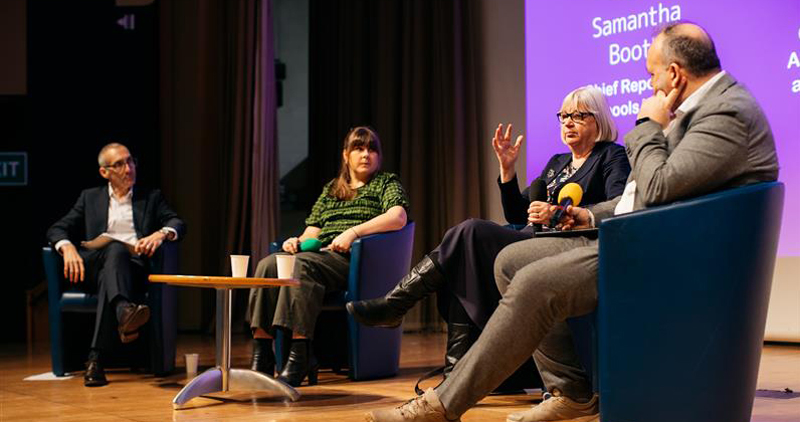
Speaking at The Difference’s IncludEd conference at the weekend, Lenehan, a former chief executive of the Council for Disabled Children, said: “When we get the white paper, which is soon, you’ll see more of the detail on that, but schools [are] very much at the heart of it.”
She said that part of her role was “making sure we have a language which enables schools to talk to health, to talk to social care, to talk to parents, to talk to pupils”.
The government’s ongoing reforms have prompted debate about the term “SEND”.
Tom Rees, the government’s adviser on inclusion, has previously said he would like to see the term “retired, because we’ve become much more precise in our understanding of different needs”.
Lenehan said at the conference that SEND was “such an amorphous context…it means nothing. It’s a word that’s almost meaningless.”
‘SEND as a concept’
The National Audit Office has said that about 40 per cent of pupils are identified as having SEND at some point during their time at school.
“If you think we’ve got to a stage where some of the stats give up [to] 40 per cent of children in schools with SEND, they stop being special. What does it mean?” said Lenehan.
She had been in “interesting debates about SEND as a concept. In some ways, I’d almost get rid of it.

“How did we ever end up in a world where we have children and we have SEND children, as if they themselves are some strange sub-species, when they’re clearly not?
“They’re children who have needs, and some of those needs will cross over into poverty, some will cross over into racism and some of them won’t. But they are children in a system and inclusion for me has to be all of it.”
Lenehan said she had heard regional differences during the Department for Education’s national “listening” conversation, which closed this week.
“One of the really strong feels in Leeds was the stuff around vulnerable children from socio-economically difficult backgrounds, the whole stuff about [pupils who were] previously known to social care.
“This is a whole school thing, it’s not a SEND thing anymore.”
‘Lack of evidence’ on interventions
Lenehan also said she was “really quite surprised about the lack of evidence on effective interventions and what works”.

Mark Vickers, Ofsted’s external adviser for inclusion, told the conference he hoped the new inspection framework’s focus on inclusion helped schools “to really feel as if your work is being acknowledge, understood and recognised … because it gives you the opportunity to describe the work you’re doing on a daily basis”.
Another key element of the government’s white paper is expected to involve more training for staff on how to support pupils with SEND.
It comes after Schools Week documented how special educational needs’ co-ordinators in schools were “burnt out and isolated”.
The number of teaching vacancies mentioning “SENCO” or related terms soared from 37,737 in 2018-19 to 76,633 in 2023-24, SchoolDash analysis commissioned by Schools Week showed.
Speaking at IncludEd, Pepe Di’Iasio, the general secretary at the Association of School and College Leaders, called for the sector to “cherish your SENCO”.
“We need to wrap our arms around them and we need to make sure that we give them everything that we possibly can do, because… if you don’t know they are the most important person in the school, then you should do. And the new Ofsted and new accountability framework is shining a massive light on them.
“There’s an intensity on them, a level of interrogation on them that is greater than it ever was a year ago.”



[ “making sure we have a language which enables schools to talk to health, to talk to social care, to talk to parents, to talk to pupils”. ] So more and more for schools to do with health (that cannot recruit specialist staff); social care (which is unable to provide necessary support and resources); patents (who are frequently baffled by conditions and processes that they do not understand) and pupils (who are often unable to understand why they are having challenges in education). Now that’s going to work well, then, isn’t it?